Tuesday, April 21, 2009


Monday, April 20, 2009
Sunday, April 19, 2009
Saturday, April 18, 2009
Friday, April 17, 2009
Thursday, April 16, 2009
Wednesday, April 15, 2009
Tuesday, April 14, 2009
Monday, April 13, 2009
Sunday, April 12, 2009
Saturday, April 11, 2009
Friday, April 10, 2009
Thursday, April 09, 2009
Wednesday, April 08, 2009
Tuesday, April 07, 2009
Friday, May 11, 2007
The Saga of Conn the Black - Canto V
Canto V
The hearth-fire crackled brightly,
In the circle round of upturned faces,
Brows blood-crimson in the dancing flames,
Leathery wrinkles shadow furrowing,
Beards waggling as jaws clench.
Conn glanced for friendly features
Among the assembled chieftains.
There was wide Sean from the North,
Brian the Boar, hands glistening with meat-juice,
Curach Silverhands, Bron of the Dog
And even Timaon of the Salmon,
Yet none cast a smile at brave Conn.
Sternest of all was Sluatha, King,
Legs thrust out wide and hand on thigh.
“Why do you intrude, Oath-breaker?”,
Voice but a growl as the words spat onto the floor.
Slán
Silverwolf
http://gateway.batcave.net
Monday, May 07, 2007
The Saga of Conn the Black - Canto IV
Canto IV
Then stood Conn the bold square before the door.
Collum knew well that Conn would pass his way.
Well he knew the words of truth,
Born from happier times, free from fear,
Times when Druid or Bard would wander
The land's long length,
Their words alone, safe passage.
A decision made, his spear was raised
And his arm outstretched for Conn to take.
Then both men stood arm to arm,
The warmth of battle-brothers firing their hearts,
The joy of ale to come and bread in the stew,
The tales of old memory flowing free
As a spring's sun-filled bubbles.
"Enter within, friend," said Collum.
"You'll find all at feast in the clan-hall."
--- ++ ---
Animal movements rustling in the dark,
Snuffling and bleats told Conn where he was.
Low walls of rough stone surrounded
Dark shapes of wattle, mud and thatch
Enwreathed in night-time fire smoke
As noises of tired people drifted on the air.
In the centre around a warm, ruddy glow
The largest dark shape loomed in front of him,
A sharp mound deeping against the stars.
Conn strode to the door, ancient wood ajar,
And halted he there to find his centre.
Decision of a sudden, he thrust out his hand
Striding forward from chill air into warm air,
From warm comradeship into chill stares.
Slán
Silverwolf
http://gateway.batcave.net
Sunday, May 06, 2007
The Saga of Conn the Black - Canto III
Canto III
Tall and straight, Collum the Warden,
Gate-keeper, stalwart and worthy.
Fair braids tumbling onto shoulders broad,
Spear-shaft strong in steady hand,
Holding its point to Conn's proud heart.
"Whither goest thou?" in voice of thunder,
"And whence have you come?"
Conn's eye-hair raised in unspoken question
And he paused a while - an emerald fire.
"Know you me well, Collum of the gate.
We have stood shoulder to shoulder
On the line of rending death.
We have called loud to the same gods
And broken our fast at the same board.
Why do you ask me such?"
Then Collum the Tall, bending his head
With shame-glimmers flashing through his eyes:
"'Tis the Word of the King, old friend,
That none enter whom he hath not named.
I know of your worth, as does he,
But for the mead... I have said too much."
Then stood Conn to the ground, tired feet
Squelching in the mud of a host's passing,
His eyes straying through the gate
At the flickering light beyond.
Then smiled he at Collum and clapped
Hand to tired shoulder.
"Tell me, my friend, have the old laws
Of guesting and fire fallen by the way?
Is a tale or words from afar
No longer the price of a meal!
These are the gifts I bear, spear-brother,
And I can give them to none but the King."
Slán
Silverwolf
http://gateway.batcave.net
Saturday, May 05, 2007
The Saga of Conn the Black - Canto II
Trees waving proud in full leaf,
The ground wet and deep beneath hoof,
The wind rushing from a screaming sky
Howling with the pounding and heavy breath
Of the moss-brown stallion, heaving and sweating.
Lightning sparks flying from stones
As iron-shod hooves dance up the hill
Towards the mound, the dun, black against the sky.
Conn the Black, he of a thousand battles,
Thrice blessed and thrice cursed,
Son of Donan, son of Crom the Red,
Hailing from the Westmarches,
Deep within the marsh mists,
Fey-friend and wielder of the Flaming Brand,
Bending forward into the stallion's whipping mane,
His breath ragged, his hair crow-dark with life of its own
His eyes warm glowing with emeral fire.
Urgent, he urged Blackmane on
His message a sword cutting the threads of time.
Two paths spread from this moment -
The message the cross-roads.
Urgent was the news, urgent for ears to fly to.
The lips of brave Conn trembled,
Trembled to let loose the fateful words,
His heart beating pace with hammering hooves.
Slán
Silverwolf
http://gateway.batcave.net
Friday, May 04, 2007
The Saga of Conn the Black - Canto I
Canto I
Long have I stood, watching the trees,
The Skies ever-changing, the grass around my toes,
Living and ever-living, undying
The Voice of the Ages.
I tell the story of Men,
Of the sons and daughters of men,
Some long forgotten, others etched in stone.
I am the song of the breeze
Amongst the waving meadowsweet.
I am the voice of the heart unsung,
The harp unstrung, the plan undone.
Three songs have I sung in ancient times:
The song of the battle on the plains of blood,
Where men stood, died and stood again;
The song of the long-armed and the silver king,
When the champion's cup was passed around;
The song of the Hound, the Hound from the North,
With chariots thundering in a cloud of dust.
These songs have I sung, yet more are to be.
The tale of Conn, thrice renowned;
Conn the Black, with heart pure as thistledown,
Son of Donan, son of Crom the Red,
A tale that grew in the telling,
Told by the bards that tasted the blood
Spraying like spittle from dying heroes.
From heart to hand the song takes its flight
And now it is my geas
To loose the music from my harp,
As the words come stumbling into trembling song,
Building a swell of saga - a tale to be told.
Slán
Silverwolf
http://gateway.batcave.net
Wednesday, May 02, 2007
ETYMOLOGY OF THE WORD 'BARD'
ETYMOLOGY OF THE WORD 'BARD'
The word is a loanword from Proto-Celtic *bardos, ultimately from Proto-Indo-European *gwerh2: "to raise the voice; praise". The first recorded example is in 1449 from the Scottish Gaelic language into Lowland Scots, denoting an itinerant musician, usually with a contemptuous connotation. A Scots ordinance of ca. 1500 orders that "All vagabundis, fulis, bardis, scudlaris, and siclike idill pepill, sall be brint on the cheek". The word subsequently entered the English language via Scottish English.
Slán
Silverwolf
http://gateway.batcave.net
The word is a loanword from Proto-Celtic *bardos, ultimately from Proto-Indo-European *gwerh2: "to raise the voice; praise". The first recorded example is in 1449 from the Scottish Gaelic language into Lowland Scots, denoting an itinerant musician, usually with a contemptuous connotation. A Scots ordinance of ca. 1500 orders that "All vagabundis, fulis, bardis, scudlaris, and siclike idill pepill, sall be brint on the cheek". The word subsequently entered the English language via Scottish English.
Slán
Silverwolf
http://gateway.batcave.net
Wednesday, April 25, 2007
The Fountains of Youth
Is a golden dream-light streaming
Like eve through an opal west.
We sing to the sun-god, calling
By his name of yellow fire.
The touch of the dew-wet grasses,
The breath of the dawn-cool wind,
With the dawn of the god-light passes
And the world is left behind.
We drink of a fountain giving
The joy of the gods, and then –
The Land of the Ever-living
Has passed from us again.
Passed far beyond all saying,
For memory only weaves
On a silver dawn outraying
A cloud of daffodil leaves
By George William Russell [1867-1935]
The Irish Theosophist, September 1897.
Slán
Silverwolf
http://gateway.batcave.net
Like eve through an opal west.
We sing to the sun-god, calling
By his name of yellow fire.
The touch of the dew-wet grasses,
The breath of the dawn-cool wind,
With the dawn of the god-light passes
And the world is left behind.
We drink of a fountain giving
The joy of the gods, and then –
The Land of the Ever-living
Has passed from us again.
Passed far beyond all saying,
For memory only weaves
On a silver dawn outraying
A cloud of daffodil leaves
By George William Russell [1867-1935]
The Irish Theosophist, September 1897.
Slán
Silverwolf
http://gateway.batcave.net
Thursday, April 12, 2007
New RSS Feed details
The feed details for this blog have now been updated as you will see by the banner at the top of the page. I urge you to subscribe to the new feed URL as it has slightly more functionality than the standard Blogger feed.
You can subscribe using this icon:
This icon will provide a SmartFeed for any RSS compatible reader. If you would prefer, you can receive the feed via email whenever a new item is published. To do so, please use this link:
Subscribe to Silverwolf's Blog by Email
Either way, I hope this enhanced functionality helps you to enjoy the Blog.
Slán
Silverwolf
http://gateway.batcave.net
You can subscribe using this icon:
This icon will provide a SmartFeed for any RSS compatible reader. If you would prefer, you can receive the feed via email whenever a new item is published. To do so, please use this link:
Subscribe to Silverwolf's Blog by Email
Either way, I hope this enhanced functionality helps you to enjoy the Blog.
Slán
Silverwolf
http://gateway.batcave.net
Wednesday, January 31, 2007
Brief Enchanter
Tears coursed down my cheeks as I plunged across the station platform towards the door held open for me by the friendly guard. My heels clattered on the tiles and kicked up small sprays of water from the rain-drenched platform. All I could see was a dark, chiselled face in front of me with pain wrinkling his fine features. Rainwater dripped from my hair onto my face, mixing in tiny rivulets with salty tears. My chest heaved with my sobbing in time with the breaking of my heart. The guard watched me worriedly as I plunged into the tender light of the carriage. How could this happen to me? How could I have let it happen to me?
Can it only have been thirty minutes ago that I was standing in a pool of rain-specked orange light, watching the sheets of tiny jewels rush onto the dark ground just outside of my vision? Pulling back my raincoat sleeve, I looked at my watch with a sigh. It was half past nine already. When was that train going to arrive? Delayed again, no doubt. Probably because of leaves on the line. The concrete pillar next to me, redolent of the grime of a thousand trains, seemed to sigh with me in knowing exasperation. I stamped my feet to try and shake off the chill seeping into my bones. At least I was dry under this black awning, lit by these unearthly orange cones of light. Dry and alone. For a second, fear started clawing at my belly with its uneasy fingers.
My chest jolted with sudden electricity as I heard a scraping noise behind me. Heart thumping out its primal rhythm of panic, I spun towards the sound and realised that the waiting room was not as empty as I had assumed it to be. There was a dark male shape seated calmly in the shadows, its face concealed by the door jamb. He must have been watching me. All the time that I was fidgeting nervously on this platform; scratching my nose and playing with my hair I had been the subject of his quiet inspection. My fear subsided to be replaced by a quiet indignation and embarrassment. I would go into that sheltered den and confront my silent accuser – sit down on that bench and show him that I am unaffected by his gaze.
Pushing open the grey, flaky paint door I took a step across the threshold and into another world. He looked up at me and his eyes, the deep azure of the Mediterranean, took hold of my soul with unstoppable mesmeric power. Meanwhile, a gentle smile caressed his lips with a welcome for me that wrapped itself around me like a thick winter coat. Standing calmly, he stretched his arm out towards the bench.
“Hello. Please. Have a seat.”
“Thank you sir,” I found myself replying and delicately seated myself a body’s width away from him. Smiling genuinely at him I tossed my hair back from my face, fluttering my eyelashes with a tremour. I could feel the heat rise to my cheeks. How can he have such a dramatic effect on me? I am no lovelorn teenager, hormones raging out of control through my newly awakened womanhood. He sat back down, and I saw the clean line of his teeth slide behind his lips. He was a bright flame against the walls behind that had probably once been a shade of magnolia. I sat in silence for a second trying desperately to marshal my thoughts and my common-sense.
“My name is Christian,” he said as if it were the most natural thing in the entire world to say to a rain-drenched woman struggling with her own desires. Slow and tender warmth spread through my belly and I bent my head forward as if to hide my traitorous eyes.
“Natalie. Nice to meet you,” I replied, aware that I was misrepresenting the depth of my feeling.. The lie spilled from my lips easily enough but the realisation that I was captured by the sapphires of his eyes that seemed to know so much about me rocked my very foundation. It was as if he could read the lines of my soul with the merest glance.
The mute darkness was split by the thundering of an express train as it hurtled past our door pushing a wave of impacted air and solid sound before it. I saw Christian’s lips move but heard no sound over the earthquake that was just outside. I took the moment to gather my thoughts. I felt as if my entire being were on the precipice of a momentous decision. One false step in either direction would ensure a plummet into a chasm of darkness and despair just as deep as the timeless night on the other side of the platform. The moments of my life up until this point seemed to be no more than preparation for this initiation of fire. I was terrified - terrified to face the unknown within my own heart. Silence crept back upon us and I looked back at Christian as he leaned slightly towards me.
“You look upset Natalie,” he said, the words rolling over me like a warm blanket. “Is there anything I can do?” The beseeching of his eyes, the brows slightly lifted seemed to highlight the torment wrenching inside me. The shadows washed away from his face like a receding tide and his hands were moving on his knees as if striving to reach for me but held fast by the strength of his will. They were the hands of an artisan, large but perfectly formed with a hidden strength rippling just under the taut flesh. What art could this man be master of? What notes of exquisite music could those fingers draw from my battered soul? With mute desire in my eyes I gazed up at him and he reached across to take one of my hands in his warm, strong grasp.
“Christian!” I whispered hoarsely and slid across the bench, my head burying itself into the coarseness of his grey jacket. I threw my arms around him as if by strength alone I could capture this precious moment for all eternity. My heart swelling with need for this stranger, I could no longer hear those small voices in the back of my mind which read from the history book that my life had written. All I could hear was the deep drum-beat of desire in this man’s body holding a counterpoint to the pulse of my lifeblood as it throbbed in my temples and warmed my being. Meanwhile, his strong, trembling arms had wound themselves around me and held me close to his chest. His head lowered towards me and I felt the warm breath from his lips caress my forehead with a touch as light as thistledown.
“Let me come with you,” I begged with a voice hoarse with emotion.
“Natalie – stop.” He spoke to me in a voice like hot chocolate on a winter’s evening. “I have been waiting for you to enter my life since I first took a razor to my chin. You have filled my dreams with your grace, lit my nights with the light from your eyes and danced through my desire like a bewitching elf.” Tightening his arms around me, he continued: “My love for you would hold you at my side until the stars all fade away but I can hardly believe that this is real. Are you sure that this is what you want?”
I looked up at his face, half-lit by the yellow light above us and the flickering orange lights just outside and it seemed for a moment that the solid blue of his eyes cracked and shimmered with his doubt. I thought of Sean, waiting for me patiently at home with his feet up on the chair and his face glowing with the pallid, ever-changing reflection of the television he was watching. He would have a beer by his side, frosty glass filled with broken rings of old froth and he would flick impatiently at an ashtray on his knee. The smell of Christian’s after-shave wafted through my reflection and brought me back sharply to the present.
His face was hovering over mine and his mouth opening for the touch of my lips. Those glowing eyes were half-closed in eager anticipation. I could feel the impression of those lips in my imagination – as imperative as the encircling arms around me. I couldn’t breathe and felt claustrophobic in an aura of passion. The only relief would be to give into it and let my desire drive my willing mouth.
At that moment the loudspeaker above us blared into life and an unreal nasal voice informed us that the eight thirty from Victoria was approaching the station. An image of Sean came unbidden to my mind. I could see him standing next to me, all top hat and tails, carnation in his buttonhole and love in his glowing face. The hand that gripped mine was trembling and the promises that I had made came back to me like axes in the night; each one thudding with deathly finality into the aura of passion that was slipping rapidly away from me.
I could bear it no longer. I struggled away from Christian and rushed to the waiting-room door as the huge, metal monster screeched to a halt in a rush of wind and rain. Turning back to Christian, my apologies fell onto deaf ears and my heart caught in my throat as his face slid back into the shadows, a mask of darkness covering the searing pain coursing through him. My tears fell freely and I plunged into the concealing rainfall towards the gentle light of the train.
My one and only attempt at romantic fiction :)
Slán
Silverwolf
http://gateway.batcave.net
Monday, January 29, 2007
The Old Beech
The wild wood reaches out,
Long twisted arms of ancient oak,
Waving branches of young birch,
Rustling and sighing throughout
The fields of living grass.
Its' eldritch shadow twists and turns,
Painting jagged silhouettes
Over rugged, untrodden meadow.
A single beech stands erect
And ancient, tall in its years,
wide in its shadow circled round.
No bird, no squirrel or woodland
Creature disturbs its peace -
Just the breeze rustling angry leaves.
The Wild Wood beckons – its ancient call
Loud and omnipresent, its reach extending
As shadows lengthen, and Twilight creeps.
Well-worn tracks filled with stone
Lead off into darkness cracked
by light amongst weaving branches.
Coldness and damp seep from the earth,
And the wood closes its doors over the path.
All is still – grave-quiet and black.
No wind, no birdsong, no rustling.
Twisting and turning the way bends
This way and that, confusing the senses,
lost in shadows, in dark trees, in thought,
Winding slowly upwards on some unseen hill,
As if purposefully leading to somewhere,
A hidden spot, an unseen glade,
Somewhere of light amidst darkness,
Underneath the bare-seen Moon.
Creeping darkness deepens dimly
Foreshadowing the deepest dark.
Temple-like, a hidden circle
Stands beneath the canopy
Of an even older Beech, its
Spreading arms each a tree-trunk
Pointing the way to the four corners,
Its mountainous crown upheld
By legs that have withstood
The centuries, its unseen eyes
A thousand lives have watched
As man and woman have passed
Out of sight, sound but not memory.
And, oh! The terrors that
It has been forced to witness,
Its unwilling judgement untold.
Yet it stands not unaffected
By the darkness around it.
Years of elder torment, called
Upon and reinforced by men
In whom the darkness has taken
Long, deep roots, call forth
The fore-boding as the circle round
Tries to retain its quiet brood.
A song of light begins quavering
Amidst the throng of pressing dark,
Gathering strength as the fire slowly burns -
Pushing back the seeping gloom.
The circle of hatred expands and thins,
But the song has not gone unheard.
An ancient Terror dwelling deep
In the blood-soaked earth hears the call.
In anger, it bellows and rushes to the fray.
The song wavers but durst not die
Lest the light be quenched and
Darkness return - forever claiming
This corner of twisted, faerie realm.
In battle are joined – gloom and doom,
Unbidden are rising like angry embers,
Exhaustion is imminent, one life against many
But then, unseen amongst hidden trees,
Hidden in darkness beyond the edge,
A white Stag, ancient and proud
Lifts its quivering muzzle, tosses
its branching antlers and lifts its head,
Eyes dark with aeons-old wisdom,
And bellows the song of life,
Joining the song of light and
Breaking the hold of the Ancient One.
The Terror flees deep within the earth,
And the guardian gloom is broken,
bound and tied.
One small step to free the ancient Beech,
A gleam of hope for future cleansing.
Deepest tiredness sags and weighs down
But the Moon riding high sends rays
Of sheerest healing deep within the soul.
It has left a scar – but not one unhealed.
Slán
Silverwolf
http://gateway.batcave.net
Haiku
Soft Lavender buds
Stalks reaching bristle
Snip! The bush is pruned with shears
Slán
Silverwolf
http://gateway.batcave.net
Tuesday, January 23, 2007
Inspiration
Breathe into me the wild,
The boundless, the beauty of the child.
Let me drink deep the endless cup,
The cauldron, the grail – let me sup
Deep and my soul be filled.
To those behind the face of form,
Present since the time of Dawn,
Ever-here, everywhere – seen and unseen,
I call on you to wipe my soul clean.
Let he who ever-chatters be stilled.
Let us be one, you and me,
The tired and bound, the wild and free.
Sing to me in voice pure and clear,
Open my mind so my ears can hear.
May the words of my pen be truly skilled.
You and I have known each other long,
Aeons have passed since your first song
Filled my heart and drove me to tears.
Yet have I grown deaf over the years -
Logic and reason have been my shield.
Now I hear you sigh in the whispering grass,
Hear your laugh amongst leaves as I pass.
Let my ears finally hear your voice.
Be aware – that I have made this choice
At whatever cost, let them be healed.
Slán
Silverwolf
The boundless, the beauty of the child.
Let me drink deep the endless cup,
The cauldron, the grail – let me sup
Deep and my soul be filled.
To those behind the face of form,
Present since the time of Dawn,
Ever-here, everywhere – seen and unseen,
I call on you to wipe my soul clean.
Let he who ever-chatters be stilled.
Let us be one, you and me,
The tired and bound, the wild and free.
Sing to me in voice pure and clear,
Open my mind so my ears can hear.
May the words of my pen be truly skilled.
You and I have known each other long,
Aeons have passed since your first song
Filled my heart and drove me to tears.
Yet have I grown deaf over the years -
Logic and reason have been my shield.
Now I hear you sigh in the whispering grass,
Hear your laugh amongst leaves as I pass.
Let my ears finally hear your voice.
Be aware – that I have made this choice
At whatever cost, let them be healed.
Slán
Silverwolf
Saturday, January 20, 2007
The Young Shaman
Deep in the heart of the jungle, a wizened Indian sat by the smoking fire and gazed at the red-lit face of the young apprentice opposite him.
“Breathe in deeply of the air of the jungle” he whispered as the young man closed his eyes.
“But I can't see anything!” the young man's tremulous words spilled out. His shoulders were taut and his hands tightly clenched.
“Relax – and breathe with the beat of the jungle, listen to the life of the fire,”
His apprentice's shoulders deliberately dropped and his face lost the lines of care as he relaxed. His hair twitched in the silent breeze and the old man waited, smiling. The young man started to breathe a little harder and beads of sweat broke out on his forehead.
“I'm afraid...” he started to say, his voice seeming to come from a long way away. “I can hear a great thumping noise and it's coming towards me!”
“Greet it eagerly, my son.”
“But...”. Then the young man relaxed. A smile started to creep along his mouth. “It's the eldest of the land, master -one of the tall ones, long in leg, large in body and with eyes bright with ancient wisdom.!”
“Is he looking at you, my son?”
“Yes, and his trunk is curling around my shoulders.”
The old man stood up and placed a gentle hand on top of the dark, black hair of his apprentice.
“The Elephant spirit has accepted you – be proud, for he is long of memory and full of wisdom. Let him guide you and make a totem for him to always link you to him.”
The young man left the clearing and returned to his village. There, after many days, he chose a special piece of wood from an ancient acacia tree and started to carve. He carved a wide bracelet to fit on his young arm and the Elephant was pleased.
In the fullness of time, the spirit urged him on to pass the wisdom to another and he journeyed long to the large Town and the Elephant guided him to a tourist – a stranger in his land. Without a word, he passed the bangle on and its journey thereafter became a mystery, known only to the shaman's totem spirit. Eventually it came to this country where it was worn with pride, its wisdom seeping slowly into the bones of its owner.
The old man smiled – nothing is forgotten, nothing is ever forgotten.
Slán
Silverwolf
Wednesday, January 17, 2007
Tuesday, January 09, 2007
Haiku
Screaming bright gulls wheel
Bulbous swirling clouds
The cat drips wet and peeks out
Slán
Silverwolf
Bulbous swirling clouds
The cat drips wet and peeks out
Slán
Silverwolf
Monday, January 01, 2007
Monday, December 25, 2006
Friday, August 25, 2006
Boadicea's grave 'under McDonald's restaurant' in Birmingham
 |  Statue of Boadicea in London |
The grave of ancient warrior queen Boadicea may have been discovered under a McDonald's restaurant, archaeologists said today.
Digs beside the burger bar in King's Norton, Birmingham have uncovered Roman artefacts which archaeologists think may have been the location for the famous battle between Boadicea's army and the Romans in 61AD.
Local councillor and archaeologist Peter Osborn said: "We know for certain that the battle between the 200,000 ancient Britons and the Romans happened somewhere in the Midlands.
Read the full story here.
Thursday, August 03, 2006
Bronze Age boat is uncovered
Wednesday, August 02, 2006
Bronze Age boat is uncovered
"THE village of Netley, in Rathnamaugh, Crossmolina, was the scene of some painstaking work this week as archaeologists toiled to excavate a prehistoric logboat discovered some weeks ago in the area.
The dugout or logboat was stumbled upon in the course of pipe laying works as part of the Ballina Regional Water Scheme being carried out by Ward & Burke. Upon the discovery, on Sean and Aileen Gough’s land in Netley, Mayo County Council enlisted a team of archaeologists to assess and unearth the artefact. Following a visit to the site, The National Museum has expressed significant interest in the find.
Site Director, Ms Joanna Nolan, told the Western People: “The boat dates back to pre-historic times; obviously a tree-trunk boat, it is most likely Bronze Age which would be 3000 years ago”.
Considering the amount of land improvement that has been carried out in the region, this discovery is a fascinating one, with the canoe-like structure clearly some form of wooden boat. The team, which includes archaeologists Gary Burke, Roísín Burke, Eileen Padden, Gerard Mohan, John Kerrigan, Paul Clarke, Oliver Murphy and Michael McTighe under the direction of Joanna Nolan, delicately removed the soil strata by brushing and created a support-system"
Slán
Bronze Age boat is uncovered
"THE village of Netley, in Rathnamaugh, Crossmolina, was the scene of some painstaking work this week as archaeologists toiled to excavate a prehistoric logboat discovered some weeks ago in the area.
The dugout or logboat was stumbled upon in the course of pipe laying works as part of the Ballina Regional Water Scheme being carried out by Ward & Burke. Upon the discovery, on Sean and Aileen Gough’s land in Netley, Mayo County Council enlisted a team of archaeologists to assess and unearth the artefact. Following a visit to the site, The National Museum has expressed significant interest in the find.
Site Director, Ms Joanna Nolan, told the Western People: “The boat dates back to pre-historic times; obviously a tree-trunk boat, it is most likely Bronze Age which would be 3000 years ago”.
Considering the amount of land improvement that has been carried out in the region, this discovery is a fascinating one, with the canoe-like structure clearly some form of wooden boat. The team, which includes archaeologists Gary Burke, Roísín Burke, Eileen Padden, Gerard Mohan, John Kerrigan, Paul Clarke, Oliver Murphy and Michael McTighe under the direction of Joanna Nolan, delicately removed the soil strata by brushing and created a support-system"
Slán
Sunday, July 30, 2006
Shawbost Norse Mill and Kiln

I know this is strictly speaking not Celtic, but it is of interest and does concern our nieghbours and cousins. The Norse occupied the Hebrides for nearly five hundred years, between the end of the eighth century and the end of the thirteenth century. This long period of coexistence left a profound impression on the culture and archaeology of the Western Isles, one that is often underestimated in the light of the succeeding centuries of Scottish affiliation. Although the term Norse is often used in relation to these structures, it seems likely the design was introduced from Ireland. More info here www.culturehebrides.com/heritage/agriculture/
"As you pass along the A858 in Western Lewis near the township of Shawbost (Siabost) watch out for a brown tourist sign pointing west towards a Norse Mill.
From the small car park, a well made path leads for a quarter of a mile to two traditionally constructed and thatched stone buildings set into a small river valley. Lewis was once home to as many as 200 small horizontal wheel mills. What is variously know as Shawbost Mill or the Mill of the Blacksmiths remained active until the 1930s, though the last still operational in Lewis only stopped turning in 1945.
Shawbost Mill was first restored in the late 1960s, but the current restoration dates back to 1995. The high quality path was added in 2003.
The building you see on your right as you approach is the kiln. It isn't immediately obvious how this worked, but half the floor area comprises a raised stone platform within which is set a circular stone-lined pit. This presumably contained the fire that heated and dried the grain spread out around the remainder of the kiln.
The mill is more immediately spectacular, though here much of the workings are set in a chamber below floor level. Water from the nearby burn was led into a mill lade some way upstream from the mill. It was then channelled to the top of a mill race just behind the mill itself. From here a steep chute directed it down onto one side of a circular set of paddles, set horizontally in a chamber directly beneath the mill. The water turned the paddles, which caused the upper of the two millstones in the mill itself to turn, which in turn ground the grain. Part of the mechanism jogg"
Slán
Pipe-layers unearth bit of history
"Pipe-layers unearth bit of history
WORKERS laying new water pipes around Bridlington have tapped into a previously undiscovered part of the area's history.
Contractors have found the remains a 2,000-year-old village near Thornholme, including children's and animals' bones, British and foreign pottery, coins and the outline of a roundhouse.
 Thornholme Rome settlement dig. (PA0630-7d)
Archaeologists have des-cribed the find as significant and teams are now sifting through a field off the A614 looking for more artefacts.
Site manager Ben West-wood, from Northern Archae-ological Associates, said: 'The earliest pottery we have so far had dated for the site indicates that it is from the second century. The latest is a coin from the late third or maybe fourth century.
Site manager Ben Westwood. (PA0630-7f)"
"The items are incredibly well preserved, especially the young bones, and we think the site was occupied for 200 or 300 years from what we have uncovered here so far."It's significant because it adds to the picture of what we know about Roman settlements and the people who were living in this area of the Yorkshire Wolds.
Thornholme settlement dig. (PA0630-7h)
Slán
WORKERS laying new water pipes around Bridlington have tapped into a previously undiscovered part of the area's history.
Contractors have found the remains a 2,000-year-old village near Thornholme, including children's and animals' bones, British and foreign pottery, coins and the outline of a roundhouse.
Thornholme Rome settlement dig. (PA0630-7d)Archaeologists have des-cribed the find as significant and teams are now sifting through a field off the A614 looking for more artefacts.
Site manager Ben West-wood, from Northern Archae-ological Associates, said: 'The earliest pottery we have so far had dated for the site indicates that it is from the second century. The latest is a coin from the late third or maybe fourth century.
Site manager Ben Westwood. (PA0630-7f)"
"The items are incredibly well preserved, especially the young bones, and we think the site was occupied for 200 or 300 years from what we have uncovered here so far."It's significant because it adds to the picture of what we know about Roman settlements and the people who were living in this area of the Yorkshire Wolds.
Thornholme settlement dig. (PA0630-7h)
Slán
3,000-Year-Old Log Boat To Be Raised From Tay Estuary
 "Excavations are underway on the Bronze Age log boat. Courtesy Perth and Kinross Heritage Trust
One of the oldest boats discovered in Scotland is being excavated and raised from its site in the Tay Estuary.
The Carpow log boat, as it is known, situated near Abernethy, was discovered in 2000. Identifying it as a log boat, used for fishing and wildfowling, Perth and Kinross Heritage Trust radiocarbon dated it to 1000BC - the late Bronze Age.
Archaeologist David Strachan of the Trust explained: "It was discovered in 2000 by a metal detectorist - half of it was sticking out of the mud."
"The buried portion of it was very well preserved with intact transom boards [stern timbers], but the exposed part is deteriorating."
There are records of 150 log boats from Scotland, yet only 30 survive in museums or in situ and these are often distorted by shrinkage or warping. Records show seven log boats found in the Tay estuary, but only one survives, in Dundee Museum. Found in 1860, it has been dated to about 500AD.
The Carpow log boat is not only one of the best preserved, but also the second oldest dated log boat from Scotland."
Slán
Saturday, July 29, 2006
The Stolen Child

Amazon.com is moving from selling books and other odds an ends to making movies. A sure sign that they’ve got too much money.
Variety says the online retailer is optioning the movie rights to the Keith
Donahue novel “The Stolen Child”. They won’t actually finance the
production, instead they’re shopping it around to Hollywood studios and other potential partners looking for
someone who actually knows something about movies to put it on movie screens.
Amazon.com spokesman Drew Herdner says “With our brand and our retail
experience and customers around the world we believe we can be an extremely
valuable partner in the development, marketing and distribution of this film.” In a way he’s right, though they seem more suited to a
multi-tiered marketing deal with a major Hollywood studio than actually
developing their own films. Take a look at what Starbucks did with Akeelah and the
Bee. They marketed the hell out of it in their stores and made a little money
off it, but they didn’t stick their noses into actually making movies. Something
like that seems like a better fit for Amazon.com than this.
But ever savvy Amazon.com has always been quick to jump on diversifying. On the web it's diversify or die. These days there’s almost
nothing you can’t buy on their site. In fact, you might have a hard time
actually finding the books with which they first got their selling start amidst
all the other millions of types of entertainment and shopping content.
So what exactly is The Stolen Child about? Amazon describes it as “a
bedtime story for adults”, which might give some of you horrifying flashbacks to
a certain recently released, reportedly very bad M. Night Shyamalan movie. Don’t
worry, no narfs here. In the book, two narrators tell intertwining stories. One,
an adult trying to remember his “stolen” childhood. The other, a 7-year-old
child trapped in time. Folk legends about changlings and faeries are mixed in to
link the two stories together when 7-year-old Henry is kidnapped by hobgoblins
and replaced by an imposter.
OK, so this has got to be seen :)
Slán
Thursday, July 27, 2006
Inis Oírr - a tranquil retreat
"Although there is every chance that Inis Oírr has been inhabited for 5,000 years, the earliest evidence of civilisation is at Cnoc Raithní a Bronze Age burial mound dating from 1500BC. Nearby at Teampall Chaomhán is a medieval church ruin (half buried in sand) and the 16th Century Caisleán Uí Bhríain (an imposing three-storey tower house built within a Stone Age fort). To the north of the island, golden sandy beaches offer safe swimming and stunning vistas of Connemara, while the Eastern shore boasts a shipwreck and breathtaking views of the Cliffs of Moher and the Burren. "
Now there is somewhere I'd love to go. The full article is an emotive and fascinating read.
Slán
Downs dwellers of Iron Age
"'Time team' unearths evidence of Downs dwellers of Iron Age
Jul 24 2006
ARCHAEOLOGISTS have unearthed Iron Age and Roman pottery during a week-long excavation on Farthing Downs.
Fragments were discovered in one of the Anglo-Saxon burial mounds, originally excavated by antiques collector John Wickham Flower in the 19th century.
Archaeologists working at the site believe the pottery must have been missed by Wickham Flower, as he removed all the artefacts he unearthed.
It follows the discovery of human bones in graves near the burial mounds during a dig at the site last year - held, such as this dig, in National Archaeology Week."
Slán
Jul 24 2006
ARCHAEOLOGISTS have unearthed Iron Age and Roman pottery during a week-long excavation on Farthing Downs.
Fragments were discovered in one of the Anglo-Saxon burial mounds, originally excavated by antiques collector John Wickham Flower in the 19th century.
Archaeologists working at the site believe the pottery must have been missed by Wickham Flower, as he removed all the artefacts he unearthed.
It follows the discovery of human bones in graves near the burial mounds during a dig at the site last year - held, such as this dig, in National Archaeology Week."
Slán
Ancient bones shed light on Roman Britain
"Ancient bones shed light on Roman Britain
Archaeologists uncover farmstead and infant burial site along route of modern water pipeline
Alexandra Wood
ARCHAEOLOGISTS in Yorkshire have stumbled across fascinating remains which are shedding new light on what life was like for ancient Britons under the rule of Rome.

The experts working along the route of a new water pipeline have discovered an ancient farmstead to the south west of Bridlington.
Its occupants kept cattle, sheep and possibly pigs and lived in wood-framed roundhouses which were only yards away from where children were buried in small, round graves.
So far five infant burials have been uncovered, including what is probably a foetus.
Archaeologist Ben Westwood said: 'They are all buried in the same kind of area to the south of where the houses were, literally a few metres away.
'They are really buried within the domestic core of the settlement, keeping them very close to the centre of the village.
'Adult burials in this period were outside the confines of the settlement for obvious reasons.
'These baby burials for some reason were kept close to the houses.
'It hints at all sorts of things."
Slán
Archaeologists uncover farmstead and infant burial site along route of modern water pipeline
Alexandra Wood
ARCHAEOLOGISTS in Yorkshire have stumbled across fascinating remains which are shedding new light on what life was like for ancient Britons under the rule of Rome.
The experts working along the route of a new water pipeline have discovered an ancient farmstead to the south west of Bridlington.
Its occupants kept cattle, sheep and possibly pigs and lived in wood-framed roundhouses which were only yards away from where children were buried in small, round graves.
So far five infant burials have been uncovered, including what is probably a foetus.
Archaeologist Ben Westwood said: 'They are all buried in the same kind of area to the south of where the houses were, literally a few metres away.
'They are really buried within the domestic core of the settlement, keeping them very close to the centre of the village.
'Adult burials in this period were outside the confines of the settlement for obvious reasons.
'These baby burials for some reason were kept close to the houses.
'It hints at all sorts of things."
Slán
What's Going on Here?

"The local rock here erodes into the long slabs used to construct the monument, so this is a good example of available materials influencing design and structure. The basic design - a basket (or corbeille) type structure with the perimeter stones angled outwards, is common throughout the Sahara, although usually these monuments are much smaller. A string of these monuments, situated on a ridge, overlooks an old lake bed, which sometimes contains some water (see adjacent photo). Many of the slabs seem to have been exracted from bedrock exposed where a wadi transits from the ridge where the monuments are situated, to the lower elevation basin that contained the ancient lake.
Monument building suggests increased territoriality, and this makes sense if the people who built these structure wanted to demonstrate their association with, and rights to (even ownership of), the water resources in this locality. Monument building in the Sahara started as the region was becoming more arid, and was roughly contemporaneous with the megalithic period in Europe. There is abundant evidence from the arid belt of the northern hemisphere that there territoriality, organised conflict, and monument construction increased as the climate deteriorated after about 6000 years before present. This process of increasing territoriality and social organisation eventually led to the emergence of the first large urban, state-level 'civilisations', which emerged in river valleys in otherwise arid areas. In the Sahara the only river is the Nile - in the central Saharahn regions similar processes occured, on a smaller scale, around diminishing lakes, for example in the Fezzan region of Libya, where the Garamantian civilisation emerged. "
What's all this about? Is this another one of those strange monumetns that are fey inspired?
Slán
Tuesday, July 25, 2006
Megalithic New England
Megalithic New England
It's not just Europe that has standing stones and the like:
It's not just Europe that has standing stones and the like:
The Mystery Hill complex, the largest and most sophisticated of its kind in
North America, covers over 30 acres and is composed of monolithic standing
stones, stone walls and underground chambers, most of which are aligned to
obvious astronomical points.
...noted archaeo-astronomer Byron Dix has
determined that New England is replete with underground chambers. He says, ". .
. there are some 105 astronomically aligned chambers in Massachusetts, 51 in New
Hampshire, 41 in Vermont, 62 in Connecticut, 12 in Rhode Island, and 4 in Maine.
Megalithic culture across other areas of the world is a whole new area of research for me. It is one that may reveal unexpected Celtic connections to far flung corners of the world. I have long suspected that the Celts, being natural travellers, traded, colonised and migrated throughout a lot of the world and only areas with strong archeological evidence have remained. This evidence has dictated the historian's view of Celtic history and this picture may well change and expand in the immediate future.
Dig by students reveals site may date back 10,000 years
13 July 2006
Dig by students reveals site may date back 10,000 years
The remains of at least one longhouse have been unearthed at a Schoharie Valley excavation site (New York state, USA) that professional archaeologists have called one of the most important in the state. Located on a terrace overlooking the Schoharie Creek, the excavation - named the Pethick Site - has so far uncovered more than 80,000 artifacts. The site even drew dozens of amateur archaeologists and curious townspeople midway through the eight-week dig as word spread of the chance to experience firsthand a professional archaeological excavation.
The site - in its third year of excavation - is run as a field school through cooperative effort by the University at Albany department of anthropology and the Division of Research and Collections at the New York State Museum. "This is probably the most significant excavation I've ever been a part of," said Sean Rafferty, site co-director and assistant professor. Rafferty directed a previous excavation about a half-mile away from the current site and has participated in other digs throughout his career. "It still amazes me that we found one of the most prolific sites in the state completely by chance."
In 2004, the field school was denied access to a site, called Smith-Holloway, a stone's throw away from Pethick. But, after that denial, a local archaeology enthusiast, Carleton Smith of Central Bridge, led the team to an open field where he had uncovered numerous artifacts.Shovel test pits were dug, yielding rich archaeological deposits. And the Pethick site was born.
The field school program trains undergraduate and postgraduate students in the techniques of professional archaeology. For eight weeks, students learn the basics of archaeological field work, laboratory processing and artifact analysis. Those who complete the work are then able to seek jobs at private or public contract archaeology firms throughout the country.
"We discovered a pitted stone, scraper, projectile point and part of a drill so far today," said UAlbany senior Joshua Porter of Latham. "We've been slowly excavating a fire pit on top of a storage pit, which is a pretty impressive find." Newly discovered artifacts and their carbon dating indicate that people have inhabited the site since the Early Archaic Period, dating to as early as 8,000 BCE Mounting evidence indicates it has been continuously occupied since at least 3,000 BCE.
The occupants of the Schoharie Valley at that time are generally believed to be the ancestors of modern Iroquois cultures, including the Mohawk.Numerous artifacts from that period have been recovered, including countless chipped stone waste flakes called chert, a byproduct of stone tool manufacture; projectile points, including Brewerton side-notched, Meadowood and Levanna; animal bone; seeds; and pottery chards. Many hearths, fire-cracked rock deposits, storage pits and pieces of pottery patterns have also been documented. Preliminary analysis suggests the presence of numerous house outlines and at least one longhouse.
The daylong event was planned and executed by UAlbany graduate students Steve Moragne and Jamie Moore to generate public interest in archaeology. They were surprised by the number of people who attended and their interest in the history of the Schoharie Valley."Local people often have a better idea of site locations and what types of material can be found. Our current excavation is a perfect example of the public and archaeologists working together, which I hope will continue in the future," Rafferty said.
For more information on the site in the Schoharie Valley and future excavations, call the UAlbany anthropology department, 442-4700, or the New York State Museum Cultural Education Center, 474-5976, or go to http://www.albany.edu or http://www.oce.nysed.gov.
Slán
Source: Times Union (10 July 2006)
Dig by students reveals site may date back 10,000 years
The remains of at least one longhouse have been unearthed at a Schoharie Valley excavation site (New York state, USA) that professional archaeologists have called one of the most important in the state. Located on a terrace overlooking the Schoharie Creek, the excavation - named the Pethick Site - has so far uncovered more than 80,000 artifacts. The site even drew dozens of amateur archaeologists and curious townspeople midway through the eight-week dig as word spread of the chance to experience firsthand a professional archaeological excavation.
The site - in its third year of excavation - is run as a field school through cooperative effort by the University at Albany department of anthropology and the Division of Research and Collections at the New York State Museum. "This is probably the most significant excavation I've ever been a part of," said Sean Rafferty, site co-director and assistant professor. Rafferty directed a previous excavation about a half-mile away from the current site and has participated in other digs throughout his career. "It still amazes me that we found one of the most prolific sites in the state completely by chance."
In 2004, the field school was denied access to a site, called Smith-Holloway, a stone's throw away from Pethick. But, after that denial, a local archaeology enthusiast, Carleton Smith of Central Bridge, led the team to an open field where he had uncovered numerous artifacts.Shovel test pits were dug, yielding rich archaeological deposits. And the Pethick site was born.
The field school program trains undergraduate and postgraduate students in the techniques of professional archaeology. For eight weeks, students learn the basics of archaeological field work, laboratory processing and artifact analysis. Those who complete the work are then able to seek jobs at private or public contract archaeology firms throughout the country.
"We discovered a pitted stone, scraper, projectile point and part of a drill so far today," said UAlbany senior Joshua Porter of Latham. "We've been slowly excavating a fire pit on top of a storage pit, which is a pretty impressive find." Newly discovered artifacts and their carbon dating indicate that people have inhabited the site since the Early Archaic Period, dating to as early as 8,000 BCE Mounting evidence indicates it has been continuously occupied since at least 3,000 BCE.
The occupants of the Schoharie Valley at that time are generally believed to be the ancestors of modern Iroquois cultures, including the Mohawk.Numerous artifacts from that period have been recovered, including countless chipped stone waste flakes called chert, a byproduct of stone tool manufacture; projectile points, including Brewerton side-notched, Meadowood and Levanna; animal bone; seeds; and pottery chards. Many hearths, fire-cracked rock deposits, storage pits and pieces of pottery patterns have also been documented. Preliminary analysis suggests the presence of numerous house outlines and at least one longhouse.
The daylong event was planned and executed by UAlbany graduate students Steve Moragne and Jamie Moore to generate public interest in archaeology. They were surprised by the number of people who attended and their interest in the history of the Schoharie Valley."Local people often have a better idea of site locations and what types of material can be found. Our current excavation is a perfect example of the public and archaeologists working together, which I hope will continue in the future," Rafferty said.
For more information on the site in the Schoharie Valley and future excavations, call the UAlbany anthropology department, 442-4700, or the New York State Museum Cultural Education Center, 474-5976, or go to http://www.albany.edu or http://www.oce.nysed.gov.
Slán
Source: Times Union (10 July 2006)
Front garden in Kent yields ancient tools
24 June 2006
Front garden in Kent yields ancient tools
The Britons of 250,000 years ago were a good deal more sophisticated than they are sometimes given credit for, new archaeological evidence suggests. It comes in the form of giant flint handaxes that have been unearthed at a site at Cuxton in Kent (England). The tools display exquisite, almost flamboyant, workmanship not associated with this period until now. The axes - one of which measured 307mm (1ft) in length - were dug up from old sand deposits in a front garden.
"It is a site where there would once have been a slow-moving river," explained Dr Francis Wenban-Smith, from the Centre for the Archaeology of Human Origins at the University of Southampton."It would have periodically overflowed its banks; and there would have been occasional sand bars and islands that got exposed. Obviously, at some point, Palaeolithic man was doing something there, left his handaxes, and they got covered up."
The biggest of the tools - the second largest of its type found in Britain - is beautifully preserved and sharply pointed. It was probably used to butcher prey, which at that time would have included rhino, elephants, large deer and an extinct type of cattle known as aurochs. Another big implement was uncovered immediately beside the star find; this time a cleaver, 179mm (7 inches) long by 134mm (5 inches) wide.
The culture at Cuxton is one that archaeologists refer to as Acheulian, to describe the type of stone tool manufacturing that was dominant at that time. Dr Wenban-Smith says the latest finds hint that these people were more advanced in their cognitive and behavioural development than is normally assumed. "Both handaxes come from next to each other which is an important point because it shows they were making different designs," he said. "This points to their mental capabilities. It shows that they could hold in their minds the idea of the shape they wanted to make. There are also technical traits in terms of how they were sharpened which would have to have been preconceived. To my mind, this helps prove that these people were not so far away from us as some would think and also that they were probably using language."
The Cuxton manufacturing techniques were soon supplanted by a different way of making stone tools, known as Levalloisian technology. Dr Wenban-Smith said it was unclear whether this knowledge was imported from further south in Europe or independently discovered by the Britons themselves.
Source: BBC News (20 June 2006)
Slán
Front garden in Kent yields ancient tools
The Britons of 250,000 years ago were a good deal more sophisticated than they are sometimes given credit for, new archaeological evidence suggests. It comes in the form of giant flint handaxes that have been unearthed at a site at Cuxton in Kent (England). The tools display exquisite, almost flamboyant, workmanship not associated with this period until now. The axes - one of which measured 307mm (1ft) in length - were dug up from old sand deposits in a front garden.
"It is a site where there would once have been a slow-moving river," explained Dr Francis Wenban-Smith, from the Centre for the Archaeology of Human Origins at the University of Southampton."It would have periodically overflowed its banks; and there would have been occasional sand bars and islands that got exposed. Obviously, at some point, Palaeolithic man was doing something there, left his handaxes, and they got covered up."
The biggest of the tools - the second largest of its type found in Britain - is beautifully preserved and sharply pointed. It was probably used to butcher prey, which at that time would have included rhino, elephants, large deer and an extinct type of cattle known as aurochs. Another big implement was uncovered immediately beside the star find; this time a cleaver, 179mm (7 inches) long by 134mm (5 inches) wide.
The culture at Cuxton is one that archaeologists refer to as Acheulian, to describe the type of stone tool manufacturing that was dominant at that time. Dr Wenban-Smith says the latest finds hint that these people were more advanced in their cognitive and behavioural development than is normally assumed. "Both handaxes come from next to each other which is an important point because it shows they were making different designs," he said. "This points to their mental capabilities. It shows that they could hold in their minds the idea of the shape they wanted to make. There are also technical traits in terms of how they were sharpened which would have to have been preconceived. To my mind, this helps prove that these people were not so far away from us as some would think and also that they were probably using language."
The Cuxton manufacturing techniques were soon supplanted by a different way of making stone tools, known as Levalloisian technology. Dr Wenban-Smith said it was unclear whether this knowledge was imported from further south in Europe or independently discovered by the Britons themselves.
Source: BBC News (20 June 2006)
Slán
Monday, July 24, 2006
Scottish Gaelic speakers visit Nova Scotia to help restore fading language
Scottish Gaelic speakers visit Nova Scotia to help restore fading language
James Keller
Canadian Press
Monday, July 24, 2006
HALIFAX (CP) - Olivia MacDonald hopes to be fluent in Gaelic some day.
The nine-year-old from St. Andrews, N.S., has learned the dwindling Celtic language at home from her father and in after-school programs.
And earlier this month, she participated in a weeklong immersion program with five Scottish women and their eight children, who are in Nova Scotia teaching their native tongue.
"I'm Scottish and I really like it and I think it's really cool to be with people from Scotland," Olivia says from her home in St. Andrews. "I can say a lot of things."
Olivia is one of about 120 children in three communities to take part in a series of workshops, games and other activities designed to help them learn to speak and understand Gaelic.
The group from Lochaber, Scotland, moved on to the Cape Breton community of Iona last week, and are now doing the same in nearby Mabou. The children are immersed in the language during the day, and adult classes are held in the evenings.
I wish there were activites like this in my area for Irish....
Slán
BBC NEWS | England | Somerset | Iron Age villagers 'behind times'
Iron Age villagers 'behind times'
Iron Age villagers living in west Somerset were 'behind the times' according to evidence unearthed by a team of archaeologists.
The team has been investigating the site at Maundown Water Treatment works near Wiveliscombe.
Six round houses dating back to 100 BC have been revealed by the dig.
Read more here.
Slán
Iron Age villagers living in west Somerset were 'behind the times' according to evidence unearthed by a team of archaeologists.
The team has been investigating the site at Maundown Water Treatment works near Wiveliscombe.
Six round houses dating back to 100 BC have been revealed by the dig.
Read more here.
Slán
Fight for Stonehenge takes to the air
Fight for Stonehenge takes to the air
Hot-air balloonists will highlight danger of traffic-choked roads and call for tunnel beneath monument
Robin McKie, science editorSunday July 23, 2006The Observer
A hot-air balloon will rise over Salisbury Plain tomorrow on a trip that will mark one of the country's strangest scientific breakthroughs: the 100th anniversary of the first aerial photograph of Stonehenge.
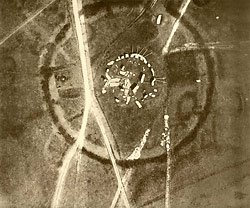
The 1906 flight was the first use of air reconnaissance for studying ancient monuments in Britain, and will be commemorated with a balloon flight of English Heritage officials and other VIPs. 'Aerial photographs are our main method for finding new [archaeological] sites,' said Martyn Barber, of English Heritage's aerial survey unit. 'They are invaluable for studying the past.'
But the trip has another purpose. It is to form part of an unofficial campaign by English Heritage to maintain public awareness of the World Heritage site. They are anxious to press ministers who have promised they will decide in the next few months on what to do with the main roads that run near the 5,000-year-old stone circle.
Also, see here.
Slán
Republican National Convention Blog NYC 2004: The Occult Life of Things
The Occult Life of Things
 | Pan-pipes thought to be imbued with the soul of the Sun-God Credit: Marcos Guerra, STRI, Smithsonian Tropical Research Institute |
Take another look at your car, your fork and knife, your personal digital assistant.
Is it possible that "inanimate objects" have a life of their own? Fernando Santos-Granero, STRI Staff Scientist, is organizer of "The Occult Life of Things," a symposium at the International Congress of Americanists in Seville, Spain on 17 July, 2006. Natives of the Amazon region consider animals, plants and objects as subjectivities that have lives of their own and are essentially social beings.
This "animistTM" vision of the world goes hand in hand with a "perspectivistTM" vision in which all beings and things view 'self' as human and "other" as non-human. The focus of the symposium is an analysis of these occult lives; occult not only in the sense that the lives of things are supernatural, but also because the human essence of things is not normally visible.
The Yanesha of eastern Peru believe that pan pipes are animated by the Sun God, the Creator, explains Santos-Granero. Before playing the pipes, Yanesha men offer fermented manioc drinks, coca leaves or tobacco juice to "raise its spirit." When they play the flute, the life-giving force of the Sun God is broadcast to all nearby beings and things.
The symposium will gather linguists and anthropologists from Europe, South America, and the United States who are specialists on Native Amazonian societies. Participants will address three major aspects of the life of things.
Slán
Sunday, July 23, 2006
Guardian Unlimited Arts | Arts news | Fight for Stonehenge takes to the air
Fight for Stonehenge takes to the air
Hot-air balloonists will highlight danger of traffic-choked roads and call for tunnel beneath monument Robin McKie, science editorSunday July 23, 2006The Observer
A hot-air balloon will rise over Salisbury Plain tomorrow on a trip that will mark one of the country's strangest scientific breakthroughs: the 100th anniversary of the first aerial photograph of Stonehenge.
The 1906 flight was the first use of air reconnaissance for studying ancient monuments in Britain, and will be commemorated with a balloon flight of English Heritage officials and other VIPs. 'Aerial photographs are our main method for finding new [archaeological] sites,' said Martyn Barber, of English Heritage's aerial survey unit. 'They are invaluable for studying the past.'
Slán
The inspiration lives on
RONALD RAE IN HOLYROOD PARK, EDINBURGH
The monumental granite sculptures of Ronald Rae form the first exhibition of sculpture ever to be held in Holyrood Park. The 21 sculptures are shown in partnership with Historic Scotland in a variety of locations around the park, and within the gardens of Holyrood Palace. They represent more than 20 years of work by the acclaimed sculptor, made in Edinburgh but never displayed together in their home city. "I thought it would be good to bring my bairns home," says Rae. "I've always been rather fond of Arthur's Seat, a geological miracle in the middle of the city. This is a sharing, a giving back to the city that I love."
Rae's sculptures are carved by hand from vast lumps of stone quarried in the north-east, and include animals inspired by Celtic and Pictish art, as well as images drawn from the Christian faith. The newest of the works is the Lion of Scotland, opposite the Parliament building, 20 tons of Corrennie granite which needed a 100-ton crane to lift it into place.
"You can't fool around with granite, you've got to be so truthful to yourself," Rae says. "The stone is a little over 470 million years old, give or take 1,000 years. It is older than the crags. It's a very humbling experience to split crystals that haven't seen the light of day for 470 million years. The stone selects me, I don't select the stone. It's punishing work, but you have to die a little in these things, you have to give your soul. They are my prayers, my celebration of life, my thankyou for being born. I like it that people can climb on these things, engage with them."
• Holyrood Park, until May 2007, www.ronaldrae.co.uk or pick up a flyer from attractions near the park.
Scotsman.com Living - Outside the gallery walls
The monumental granite sculptures of Ronald Rae form the first exhibition of sculpture ever to be held in Holyrood Park. The 21 sculptures are shown in partnership with Historic Scotland in a variety of locations around the park, and within the gardens of Holyrood Palace. They represent more than 20 years of work by the acclaimed sculptor, made in Edinburgh but never displayed together in their home city. "I thought it would be good to bring my bairns home," says Rae. "I've always been rather fond of Arthur's Seat, a geological miracle in the middle of the city. This is a sharing, a giving back to the city that I love."
Rae's sculptures are carved by hand from vast lumps of stone quarried in the north-east, and include animals inspired by Celtic and Pictish art, as well as images drawn from the Christian faith. The newest of the works is the Lion of Scotland, opposite the Parliament building, 20 tons of Corrennie granite which needed a 100-ton crane to lift it into place.
"You can't fool around with granite, you've got to be so truthful to yourself," Rae says. "The stone is a little over 470 million years old, give or take 1,000 years. It is older than the crags. It's a very humbling experience to split crystals that haven't seen the light of day for 470 million years. The stone selects me, I don't select the stone. It's punishing work, but you have to die a little in these things, you have to give your soul. They are my prayers, my celebration of life, my thankyou for being born. I like it that people can climb on these things, engage with them."
• Holyrood Park, until May 2007, www.ronaldrae.co.uk or pick up a flyer from attractions near the park.
Scotsman.com Living - Outside the gallery walls
Saturday, July 22, 2006
TIME TEAM TO UNCOVER ISLAND'S SECRETS
TIME Team will uncover the early years of Manx Christianity when the popular archaeology programme films in September.
After months of speculation, it has been confirmed the Channel 4 series will feature the Island.
A team of more than 40, including a few well-known faces, will spend three days trying to get to grips with an important area of Manx history.
Series editor Michael Douglas confirmed presenter Tony Robinson, who also played sidekick Baldrick in the BBC comedy Blackadder, will travel here.
The excavation will be overseen by respected archaeologist and Time Team regular Professor Mick Aston and Phil Harding, whose West Country accent, hats and eccentric hair have made him a favourite with fans, will also join the dig.
Mr Douglas said the filming will take place in September, but declined to reveal where because it is on private land.
However, he added: 'We're going to be investigating a keill – an early Manx chapel – that could date as far back as the 7th century, but may also contain evidence of the Viking presence in the Island.
'Almost every keill in the Island, well over 100, was investigated, dug or fiddled about with by antiquarians in the early part of the 20th century, and the general consensus now is that they missed and/or destroyed lots of important information about the early years of Manx Christianity.
'The keill we're looking at is one of the very few that was untouched by the antiquarians, so it's a unique opportunity to use all the modern techniques at our disposal to investigate the chapel and put it into the wider context of Manx life before, during and after the Vikings came to the Island.'
He added: 'It'll be a standard Time Team dig in the sense there'll be between 40 and 50 of us pitching up for the three days of filming – that number includes archaeologists, geophysics, landscape surveyors, three camera crews, production team and so on.
'Tony will, of course, be presenting with Professor Mick Aston in charge of the archaeology. Phil Harding will be leading the team in the trenches.'
A team of more than 40, including a few well-known faces, will spend three days trying to get to grips with an important area of Manx history.
Series editor Michael Douglas confirmed presenter Tony Robinson, who also played sidekick Baldrick in the BBC comedy Blackadder, will travel here.
The excavation will be overseen by respected archaeologist and Time Team regular Professor Mick Aston and Phil Harding, whose West Country accent, hats and eccentric hair have made him a favourite with fans, will also join the dig.
Mr Douglas said the filming will take place in September, but declined to reveal where because it is on private land.
However, he added: 'We're going to be investigating a keill – an early Manx chapel – that could date as far back as the 7th century, but may also contain evidence of the Viking presence in the Island.
'Almost every keill in the Island, well over 100, was investigated, dug or fiddled about with by antiquarians in the early part of the 20th century, and the general consensus now is that they missed and/or destroyed lots of important information about the early years of Manx Christianity.
'The keill we're looking at is one of the very few that was untouched by the antiquarians, so it's a unique opportunity to use all the modern techniques at our disposal to investigate the chapel and put it into the wider context of Manx life before, during and after the Vikings came to the Island.'
He added: 'It'll be a standard Time Team dig in the sense there'll be between 40 and 50 of us pitching up for the three days of filming – that number includes archaeologists, geophysics, landscape surveyors, three camera crews, production team and so on.
'Tony will, of course, be presenting with Professor Mick Aston in charge of the archaeology. Phil Harding will be leading the team in the trenches.'
20 July 2006
News - Isle of Man Today: News, Sport, Jobs, Property, Cars, Entertainments & More
Stone Pages Archaeo News: Brownslade Barrow's secrets revealed
Brownslade Barrow's secrets revealed
Archaeologists will take advantage of a summer lull in firing at the MOD's Castlemartin Range this August, to spend time unravelling the mysteries of Brownslade Barrow. The site, situated on part of the Castlemartin Army Training Estate, was first excavated over a century ago. It is believed to originate from 2300-650 BCE.
Brownslade Barrow is one of Pembrokeshire’s (England) most interesting and important historical sites; it has evidence of multiple use and the quality of remains found there during recent excavations are much better preserved than at other sites in the county. "It was partially excavated in the 1880s and is believed to have prehistoric Bronze Age origins," said Polly Groom, the National Park Authority’s Archaeologist "Evidence was found of later re-use, with burials presumed to date from the early Medieval period. Two very recent trial investigations on site revealed over 100 pieces of human bone, from at least six individuals. Radiocarbon dates put them within the early Medieval period (5th - 11th centuries CE). The remains may occupy a time span of up to 500 years. The site is really unusual in having good preservation; mostly in Pembrokeshire the soils are so acidic that the preservation of remains is very poor. This makes Brownslade even more important and interesting," she added.
The site is currently being damaged by badger burrowing, so this summer’s excavations will allow information to be retrieved before it is destroyed completely. The Ministry of Defence is funding the four-week long dig which is co-ordinated by the Pembrokeshire Coast National Park Authority and Cambria Archaeology. Information, pictures and updates will be posted online in a regular ‘dig-diary’ throughout the summer - visible on www.cambria.org.uk.
Source: Pembrokeshiretv.com (21 July 2006)
Slán
Archaeologists will take advantage of a summer lull in firing at the MOD's Castlemartin Range this August, to spend time unravelling the mysteries of Brownslade Barrow. The site, situated on part of the Castlemartin Army Training Estate, was first excavated over a century ago. It is believed to originate from 2300-650 BCE.
Brownslade Barrow is one of Pembrokeshire’s (England) most interesting and important historical sites; it has evidence of multiple use and the quality of remains found there during recent excavations are much better preserved than at other sites in the county. "It was partially excavated in the 1880s and is believed to have prehistoric Bronze Age origins," said Polly Groom, the National Park Authority’s Archaeologist "Evidence was found of later re-use, with burials presumed to date from the early Medieval period. Two very recent trial investigations on site revealed over 100 pieces of human bone, from at least six individuals. Radiocarbon dates put them within the early Medieval period (5th - 11th centuries CE). The remains may occupy a time span of up to 500 years. The site is really unusual in having good preservation; mostly in Pembrokeshire the soils are so acidic that the preservation of remains is very poor. This makes Brownslade even more important and interesting," she added.
The site is currently being damaged by badger burrowing, so this summer’s excavations will allow information to be retrieved before it is destroyed completely. The Ministry of Defence is funding the four-week long dig which is co-ordinated by the Pembrokeshire Coast National Park Authority and Cambria Archaeology. Information, pictures and updates will be posted online in a regular ‘dig-diary’ throughout the summer - visible on www.cambria.org.uk.
Source: Pembrokeshiretv.com (21 July 2006)
Slán
SUFFOLK TIMBERS COULD BE IRON AGE CAUSEWAY SAY ARCHAEOLOGISTS
The timbers are several thousand years old..
 | “This is the first such structure to have been discovered within Suffolk and is one of only a few in Britain,” said Jane Sidell, English Heritage Archaeological Science Advisor, “and as such is a nationally important find.” The timbers were found on the banks of the River Waveney, and have been remarkably well preserved with chiselled points intact. Clearly sculpted by hand, the vertical posts were uncovered during the excavation of a new dyke on Beccles Town marshes – part of a multi-million pound Environment Agency project. |
Timbers unearthed during flood defence work on the Norfolk-Suffolk border have been dated to between 3,000 and 4,000 years ago, archaeologists have revealed.
The very well preserved finds are the first of their kind in the region – it is thought they may have belonged to a walkway across the marshland in the Iron Age.


The full story can be found here.
SlánBBC NEWS | England | Humber | Workmen unearth ancient village
Workmen laying a water pipeline in fields near Bridlington have uncovered the remains of an ancient settlement believed to be almost 2,000 years old.
Archaeologists have described the find near Haisthorpe, which includes a traditional roundhouse, as significant.
They have unearthed the remains of children buried at the site, as well as coins, pottery and irrigation ditches.
The village may date back to 100AD and was undiscovered for so long because the fields have never been ploughed.
Yorkshire Water, which was carrying out the pipe-laying work, said a number of other archaeological finds had been made along the route of the new pipeline.
Archaeologists found the outline of a traditional roundhouse at the site.

Slán
Archaeologists have described the find near Haisthorpe, which includes a traditional roundhouse, as significant.
They have unearthed the remains of children buried at the site, as well as coins, pottery and irrigation ditches.
The village may date back to 100AD and was undiscovered for so long because the fields have never been ploughed.
Yorkshire Water, which was carrying out the pipe-laying work, said a number of other archaeological finds had been made along the route of the new pipeline.
Archaeologists found the outline of a traditional roundhouse at the site.
Slán
Friday, July 21, 2006
Trial a test case for the Irish Language
Sinn Fein MEP Bairbre de Brun last night called for legislation to allow court cases in Northern Ireland to be conducted in Irish.
She was speaking after 24-year old Maire Nic an Bhaird, from Woodside Walk, Dunmurry, on the outskirts of Belfast, had a charge of disorderly behaviour adjourned at the city's Magistrates Court until September 6.
Ms Nic an Bhaird, a drama teacher at Colaiste Feirste, west Belfast, denies committing the offence in May on Belfast's Malone Road.
The case is being seen as a test case by some in the Irish language community.
"Considering the European Charter, the Good Friday Agreement and the Criminal Justice Review, she should now be able to get her papers from the Prosecution Service in the Irish language," Ms de Brun said.
As Irish language activists picketed the Laganside court complex, she said her former pupil should also be able to use Irish in the actual court proceedings.
"This young woman has spoken Irish all her life and has gone through her entire schooling through the medium of Irish.
"While I would obviously prefer that she didn't find herself before the courts, a main concern for the Irish language community is that all the proceedings should now be in Irish," she said.
"In particular, it is imperative that the Prosecution Service provide the relevant papers in Irish and she herself be able to address the court in Irish," Ms de Brun, a former Stormont Executive Minister, added.
Solicitor Michael Crawford said Ms Nic an Bhaird was a native Irish speaker and her whole environment was Irish.
Mr Crawford said that as all legal proceedings had been conducted in Irish, he had written to the Public Prosecution Service requesting that all papers in the case should be in Irish also.
Resident Magistrate Fiona Bagnall adjourned the case for three weeks to allow the defence to make written submissions in support of their application and to facilitate a response from the Director of Public Prosecutions.
Ms Nic an Bhaird was released on continuing bail.
Slán
Thursday, July 20, 2006
Waterford Today - 19 July 2006 - Prime Time and High Court for Gaeltacht planning
Percentages of Irish speakers in the Déise Gaeltacht have been falling
dramatically in recent years and a double-whammy effect has been cited as the
reason for this - there are more and more people moving in who cannot speak
Irish and most of the young people of house-buying age, ready to start a family,
are moving out because they have no hope of buying a site or a house due to
sky-high property prices.
With average house prices on estates nearing the 1 million euro mark and
with some having guide-prices of up to €900,000 – it would take 3 Gaeltacht
families to buy one house between them. This talk is not sabre-rattling, the
Irish language faces extinction as a living language in Waterford within 10-15
years if the current trend is not reversed immediately. We will only
realise the significance of this when it is far too late. Having first
introduced Irish-language-speaking conditions on planning permissions for
housing estates in the Déise Gaeltacht in 2003, in 2006, 3 years later, we know
of no system put in place to actually implement these conditions.
This is awful news.
Slán
Tuesday, July 18, 2006
BBC NEWS | UK | Scotland | North East/N Isles | Excavation unearths burial site
Archaeologists believe they may have discovered one of the oldest churches in Scotland during an excavation in Aberdeen.
They are awaiting test results which will confirm whether they have uncovered a religious burial site dating back to the 6th Century.
The find was made during Scotland's biggest archaeological dig in the east kirk of St Nicholas Church.
So far 300 skeletons have been unearthed, far more than expected.

BBC NEWS UK Scotland North East/N Isles Excavation unearths burial site
They are awaiting test results which will confirm whether they have uncovered a religious burial site dating back to the 6th Century.
The find was made during Scotland's biggest archaeological dig in the east kirk of St Nicholas Church.
So far 300 skeletons have been unearthed, far more than expected.
BBC NEWS UK Scotland North East/N Isles Excavation unearths burial site
USATODAY.com - Were letters inspired by nature?
Carrying on from the investigations into the possible origins fo writing http://silverwolf.batcave.net/Ogham/Phosphenes.html I have found the above article about the possible origins of letter shapes from the natural shapes found in nature.
Although this theory has a lot going for it, I think that there is a basic flaw which may be more a matter of perspective than of error. The evidence for a correspondence between the shapes in nature and the shapes of early writing is probably quite strong, but this does not address the issue of why choose to write in the first place. What prompted the evolution of a complete system of linguistic representation using geometric patterns (or natural patterns, come to that)?
This may relate to the fact that whatever culture developed a particular writing system still has the same physiological construction as any other culture. This may be closer in explanation to the Phosphene theory.
Worth watching this researcg, I feel.
Slán
Natural shapes, contours found outdoors, appear to be the inspiration for
letters in most alphabets, concludes a study in The American Naturalist
journal.
In the study, essentially a computer analysis of letter shapes led by
theoretical neurobiologist Mark Changizi of the California Institute of
Technology in Pasadena, Calif., the researchers sorted letters by their
"topology," not their basic shape. Topology is the branch of math that
classifies and characterizes shapes.
Although this theory has a lot going for it, I think that there is a basic flaw which may be more a matter of perspective than of error. The evidence for a correspondence between the shapes in nature and the shapes of early writing is probably quite strong, but this does not address the issue of why choose to write in the first place. What prompted the evolution of a complete system of linguistic representation using geometric patterns (or natural patterns, come to that)?
In the study then, a letter like X equals any character written as two-slashes
that meet anywhere, like a "+" sign. And an "L" is the same as a "V". The team
concentrated its study on 36 two or three-segment shapes ("N" is an example of a
three-segment shape) across 97 writing systems. Looking at 1,442 letters, the
team checked the frequency of each shape, and measured how well they matched
4,759 Chinese characters and 3,538 "nonlinguistic" symbols, such as musical
notation or traffic symbols. They ran the same analysis against random scratches
and children's scribbles as a test of the method.
This may relate to the fact that whatever culture developed a particular writing system still has the same physiological construction as any other culture. This may be closer in explanation to the Phosphene theory.
Worth watching this researcg, I feel.
Slán
USATODAY.com - The hullabaloo about hobbits
More information about the little people found on the island of Flores in Indonesia.
As reported by the discovery team led by Michael Morwood of Australia's
University of New England and Tony Djubiantono of the Indonesian Centre for
Archaeology, the hobbits stood about three feet tall, and had surprisingly small
brains for critters that seemed to have scattered tools around Liang Bua cave on
Flores. Flores suffered a massive volcanic eruption around 12,000 years ago.
That may have wiped the creatures out but they have become the stuff of legend,
with islanders telling stories about the little people who once lived
there.
First reported in the journal Nature, the vituperation among
paleontologists surrounding the hobbit discovery has been almost as remarkable
as the hobbits themselves. For example, a competing archaeologist ran off with
LB1, the fossil hobbit described in the Nature report and bones from another,
returning them only after making damaging molds of the soft bones. (LB1 is the
"holotype" for the new species, sort of the gold standard by which a species is
recorded, making the damage more troubling.) Whether the hobbits are offshoots
of humanity or just brain-damaged pygmies has become a new scholarly debate in
the field of human origins.
What's all that about? What happened to honest scientific investigation?
Based on the analysis of microencephalic skulls, the team rules out the most
likely form of microencephaly for LB1. But the rest of the bones are too big a
mix to come to a definite conclusion about the ancestry of the hobbits, other
than to say, judging by their "primitive" features, they must have spent a long
time on Flores, say two million years, even further back than Homo erectus. How
hobbits got there is another mystery. But "it's attribution to a new species,
Homo floresiensis, is supported," they conclude, even if we don't quite know
what they are.
Maybe the truth is still out there?
Saturday, July 15, 2006
ABC News: Tripping Out: Scientists Study Mystical Effects of Mushrooms
July 11, 2006 — - This may come as no surprise to the flower children of
the 1960s, but in one of the few controlled human studies of a known illegal
hallucinogen, the active ingredient in "sacred mushrooms" created what
researchers are describing as deep mystical experiences that left many of the
study participants with a long lasting sense of well-being.
The controversial study, conducted by Johns Hopkins University of
Medicine, looked at whether a pill containing psilocybin, derived from the
psilocybe mushroom, would induce mystical experiences among 36 healthy adult
study participants. All had religious backgrounds, and all were also given the
active drug ingredient in the attention-deficit disorder drug, Ritalin, at a
separate time as a comparison.
The results were clear: Sixty percent of the psilocybin group elicited
behaviors consistent with a "full mystical experience" as measured by
psychological scales. Two months later, about 79 percent of the group reported
"moderately to greatly increased" well-being or life satisfaction.
I believe there has always been a strong connection between hallucinogens and shamanism. A lot more research on my part is necessary here and I hope others will help me out, but it would be fascinating to know what herbs the ancient celts had access to to stimulate these experiences, if any.
Slán
Monday, July 10, 2006
Discovery Channel :: News - Archaeology :: Stonehenge-Like Tomb Also Marks Solstice
Bryn Celli Ddu - "The Mound in a Dark Grove"
This 6,000 year old monument is aligned to the Midsummer sun.
Discovery Channel :: News - Archaeology :: Stonehenge-Like Tomb Also Marks Solstice
June 22, 2006 — An ancient British tomb monument contemporary with the first phase of Stonehenge’s construction suggests one prehistoric culture built the two structures to mark the summer solstice, according to archaeologists.
The tomb is called Bryn Celli Ddu, which in Welsh translates to "the mound in a dark grove." It is located on the island of Anglesey off the northwest coast of Wales. New radiocarbon dating of postholes outside of the burial monument determined the mound is over 6,000 years old. Stonehenge dates to around 2800 B.C., but some historians think it could be much older.
Although Stonehenge and the mound were erected at approximately the same time, Burrow told Discovery News that the construction of the mound "reflects a much older tradition."
Since the Salisbury Plain megalith also marks the winter solstice, some archaeologists have argued that winter may have been a more important time for its builders. Summer now appears to have been at the heart of many probable early rituals.
Fascinating stuff, innit?
Slán
This 6,000 year old monument is aligned to the Midsummer sun.
Discovery Channel :: News - Archaeology :: Stonehenge-Like Tomb Also Marks Solstice
June 22, 2006 — An ancient British tomb monument contemporary with the first phase of Stonehenge’s construction suggests one prehistoric culture built the two structures to mark the summer solstice, according to archaeologists.
The tomb is called Bryn Celli Ddu, which in Welsh translates to "the mound in a dark grove." It is located on the island of Anglesey off the northwest coast of Wales. New radiocarbon dating of postholes outside of the burial monument determined the mound is over 6,000 years old. Stonehenge dates to around 2800 B.C., but some historians think it could be much older.
Although Stonehenge and the mound were erected at approximately the same time, Burrow told Discovery News that the construction of the mound "reflects a much older tradition."
Since the Salisbury Plain megalith also marks the winter solstice, some archaeologists have argued that winter may have been a more important time for its builders. Summer now appears to have been at the heart of many probable early rituals.
Fascinating stuff, innit?
Slán
Sunday, July 09, 2006
Witchvox Article
Related to the study of plants associasted with Ogham, to me it sdeems fairly obvious that celtic knowldge of herbs and ehaling would be remembered with Ogham associations. This article on WitchVox could be useful:
Witchvox Article
It says:
Slán
Witchvox Article
It says:
This is not something I can see myself becoming expert at :) However, the other half is pretty handy with herbs, so perhaps I can nudge her to write an article on two on the subject for us!Herbs , as most of us already know , have different spiritual, medicinal and medical properties. Spiritually, they can aid healing and cleansing of thespirit/soul , mind and/or heart (and chakras.) Medicinally, they can assist in the healing of physical ailments and/or illnesses , and magically, they can aid in the casting and/or production of spells and/or bending of the will toward the acquisition of personal desires. If we study herbology long and hard enough, we can learn how to use herbs to our benefit in each of these ways.
Slán
Saturday, July 08, 2006
So Much More Than Fairy Stories (from The Northern Echo)
A new book explains how shield yourself from spells. Sheila Weber reports.
DID you know that Weardale has more than its fair share of faeries? Or that Yorkshire has an abundance of hobgoblins and such?
A new book spotlights the host of strange sightings of supernatural beings who inhabit these parts and, indeed, the British Isles in general.
So Much More Than Fairy Stories (from The Northern Echo)
The Book is called 'Fairies and Folklore' by Elizabeth Andrews
Slán
DID you know that Weardale has more than its fair share of faeries? Or that Yorkshire has an abundance of hobgoblins and such?
A new book spotlights the host of strange sightings of supernatural beings who inhabit these parts and, indeed, the British Isles in general.
So Much More Than Fairy Stories (from The Northern Echo)
The Book is called 'Fairies and Folklore' by Elizabeth Andrews
Slán
Friday, July 07, 2006
Commitment to community what our ancient Brehon Law can teach us in today's Ireland - Tuam Herald
This wonderful article in the Unison newspaper in Ireland, had the following to say about Brehon Law:
Commitment to community what our ancient Brehon Law can teach us in today's Ireland - Tuam Herald
Slán
Under the Brehon Laws women had more rights and protection than under any other western code of law until recent times. There was no 'glass ceiling' setting a limit on how high a woman could progress. They were political leaders, judges, physicians and led their people in battle. They were protected in law not just against rape but also against sexual harassment and discrimination. Were they to be hospitalised they would be supported by a sick benefit. They were not financially totally dependent on their partner and had an equal right to divorce.It strikes me that this equalitarian freedom applied to women under Celtic law is something that our modern societies could learn from our ancestors. Seeing that these laws were created (or at least written down) at the time of Saint Patrick, there is a good chance that earlier Celtic views on Law are represented. I must find out more about Brehon Law.
Commitment to community what our ancient Brehon Law can teach us in today's Ireland - Tuam Herald
Slán
Saturday, July 01, 2006
New Scientist Breaking News - New hobbit bones bolster separate species claim
I found this fascinating article on New Scientist that brought back to mind the discovery of the miniature skeletons in 2005. The question is: were they a separate species? What other types of extinct might be discovered?
I have always wondered about the origins of mythological creatures. Unicorns, pegasi and multitudes of fantastic creatures recorded almost globally (OK, well I exaggerate a bit!) may have some basis in history. Being of a romantic nature, I find the concept very exciting.
The stories of dwarves (and indeed giants) are well recorded in many myths - the Norse being a prime example. Fey stories in Irish lore are often associated with Little People. Perhaps, in addition to the dimunition of ancient peoples, these tales actually record encounters with other species?
New Scientist Breaking News - New hobbit bones bolster separate species claim
Slán
I have always wondered about the origins of mythological creatures. Unicorns, pegasi and multitudes of fantastic creatures recorded almost globally (OK, well I exaggerate a bit!) may have some basis in history. Being of a romantic nature, I find the concept very exciting.
The stories of dwarves (and indeed giants) are well recorded in many myths - the Norse being a prime example. Fey stories in Irish lore are often associated with Little People. Perhaps, in addition to the dimunition of ancient peoples, these tales actually record encounters with other species?
New Scientist Breaking News - New hobbit bones bolster separate species claim
Slán
Subscribe to:
Posts (Atom)