Iron Age villagers 'behind times'
Iron Age villagers living in west Somerset were 'behind the times' according to evidence unearthed by a team of archaeologists.
The team has been investigating the site at Maundown Water Treatment works near Wiveliscombe.
Six round houses dating back to 100 BC have been revealed by the dig.
Read more here.
Slán
Monday, July 24, 2006


Fight for Stonehenge takes to the air
Fight for Stonehenge takes to the air
Hot-air balloonists will highlight danger of traffic-choked roads and call for tunnel beneath monument
Robin McKie, science editorSunday July 23, 2006The Observer
A hot-air balloon will rise over Salisbury Plain tomorrow on a trip that will mark one of the country's strangest scientific breakthroughs: the 100th anniversary of the first aerial photograph of Stonehenge.
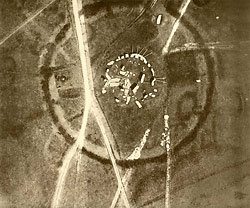
The 1906 flight was the first use of air reconnaissance for studying ancient monuments in Britain, and will be commemorated with a balloon flight of English Heritage officials and other VIPs. 'Aerial photographs are our main method for finding new [archaeological] sites,' said Martyn Barber, of English Heritage's aerial survey unit. 'They are invaluable for studying the past.'
But the trip has another purpose. It is to form part of an unofficial campaign by English Heritage to maintain public awareness of the World Heritage site. They are anxious to press ministers who have promised they will decide in the next few months on what to do with the main roads that run near the 5,000-year-old stone circle.
Also, see here.
Slán
Republican National Convention Blog NYC 2004: The Occult Life of Things
The Occult Life of Things
 | Pan-pipes thought to be imbued with the soul of the Sun-God Credit: Marcos Guerra, STRI, Smithsonian Tropical Research Institute |
Take another look at your car, your fork and knife, your personal digital assistant.
Is it possible that "inanimate objects" have a life of their own? Fernando Santos-Granero, STRI Staff Scientist, is organizer of "The Occult Life of Things," a symposium at the International Congress of Americanists in Seville, Spain on 17 July, 2006. Natives of the Amazon region consider animals, plants and objects as subjectivities that have lives of their own and are essentially social beings.
This "animistTM" vision of the world goes hand in hand with a "perspectivistTM" vision in which all beings and things view 'self' as human and "other" as non-human. The focus of the symposium is an analysis of these occult lives; occult not only in the sense that the lives of things are supernatural, but also because the human essence of things is not normally visible.
The Yanesha of eastern Peru believe that pan pipes are animated by the Sun God, the Creator, explains Santos-Granero. Before playing the pipes, Yanesha men offer fermented manioc drinks, coca leaves or tobacco juice to "raise its spirit." When they play the flute, the life-giving force of the Sun God is broadcast to all nearby beings and things.
The symposium will gather linguists and anthropologists from Europe, South America, and the United States who are specialists on Native Amazonian societies. Participants will address three major aspects of the life of things.
Slán
Sunday, July 23, 2006
Guardian Unlimited Arts | Arts news | Fight for Stonehenge takes to the air
Fight for Stonehenge takes to the air
Hot-air balloonists will highlight danger of traffic-choked roads and call for tunnel beneath monument Robin McKie, science editorSunday July 23, 2006The Observer
A hot-air balloon will rise over Salisbury Plain tomorrow on a trip that will mark one of the country's strangest scientific breakthroughs: the 100th anniversary of the first aerial photograph of Stonehenge.
The 1906 flight was the first use of air reconnaissance for studying ancient monuments in Britain, and will be commemorated with a balloon flight of English Heritage officials and other VIPs. 'Aerial photographs are our main method for finding new [archaeological] sites,' said Martyn Barber, of English Heritage's aerial survey unit. 'They are invaluable for studying the past.'
Slán
The inspiration lives on
RONALD RAE IN HOLYROOD PARK, EDINBURGH
The monumental granite sculptures of Ronald Rae form the first exhibition of sculpture ever to be held in Holyrood Park. The 21 sculptures are shown in partnership with Historic Scotland in a variety of locations around the park, and within the gardens of Holyrood Palace. They represent more than 20 years of work by the acclaimed sculptor, made in Edinburgh but never displayed together in their home city. "I thought it would be good to bring my bairns home," says Rae. "I've always been rather fond of Arthur's Seat, a geological miracle in the middle of the city. This is a sharing, a giving back to the city that I love."
Rae's sculptures are carved by hand from vast lumps of stone quarried in the north-east, and include animals inspired by Celtic and Pictish art, as well as images drawn from the Christian faith. The newest of the works is the Lion of Scotland, opposite the Parliament building, 20 tons of Corrennie granite which needed a 100-ton crane to lift it into place.
"You can't fool around with granite, you've got to be so truthful to yourself," Rae says. "The stone is a little over 470 million years old, give or take 1,000 years. It is older than the crags. It's a very humbling experience to split crystals that haven't seen the light of day for 470 million years. The stone selects me, I don't select the stone. It's punishing work, but you have to die a little in these things, you have to give your soul. They are my prayers, my celebration of life, my thankyou for being born. I like it that people can climb on these things, engage with them."
• Holyrood Park, until May 2007, www.ronaldrae.co.uk or pick up a flyer from attractions near the park.
Scotsman.com Living - Outside the gallery walls
Saturday, July 22, 2006
TIME TEAM TO UNCOVER ISLAND'S SECRETS
TIME Team will uncover the early years of Manx Christianity when the popular archaeology programme films in September.
After months of speculation, it has been confirmed the Channel 4 series will feature the Island.
A team of more than 40, including a few well-known faces, will spend three days trying to get to grips with an important area of Manx history.
Series editor Michael Douglas confirmed presenter Tony Robinson, who also played sidekick Baldrick in the BBC comedy Blackadder, will travel here.
The excavation will be overseen by respected archaeologist and Time Team regular Professor Mick Aston and Phil Harding, whose West Country accent, hats and eccentric hair have made him a favourite with fans, will also join the dig.
Mr Douglas said the filming will take place in September, but declined to reveal where because it is on private land.
However, he added: 'We're going to be investigating a keill – an early Manx chapel – that could date as far back as the 7th century, but may also contain evidence of the Viking presence in the Island.
'Almost every keill in the Island, well over 100, was investigated, dug or fiddled about with by antiquarians in the early part of the 20th century, and the general consensus now is that they missed and/or destroyed lots of important information about the early years of Manx Christianity.
'The keill we're looking at is one of the very few that was untouched by the antiquarians, so it's a unique opportunity to use all the modern techniques at our disposal to investigate the chapel and put it into the wider context of Manx life before, during and after the Vikings came to the Island.'
He added: 'It'll be a standard Time Team dig in the sense there'll be between 40 and 50 of us pitching up for the three days of filming – that number includes archaeologists, geophysics, landscape surveyors, three camera crews, production team and so on.
'Tony will, of course, be presenting with Professor Mick Aston in charge of the archaeology. Phil Harding will be leading the team in the trenches.'
20 July 2006
News - Isle of Man Today: News, Sport, Jobs, Property, Cars, Entertainments & More
Stone Pages Archaeo News: Brownslade Barrow's secrets revealed
Brownslade Barrow's secrets revealed
Archaeologists will take advantage of a summer lull in firing at the MOD's Castlemartin Range this August, to spend time unravelling the mysteries of Brownslade Barrow. The site, situated on part of the Castlemartin Army Training Estate, was first excavated over a century ago. It is believed to originate from 2300-650 BCE.
Brownslade Barrow is one of Pembrokeshire’s (England) most interesting and important historical sites; it has evidence of multiple use and the quality of remains found there during recent excavations are much better preserved than at other sites in the county. "It was partially excavated in the 1880s and is believed to have prehistoric Bronze Age origins," said Polly Groom, the National Park Authority’s Archaeologist "Evidence was found of later re-use, with burials presumed to date from the early Medieval period. Two very recent trial investigations on site revealed over 100 pieces of human bone, from at least six individuals. Radiocarbon dates put them within the early Medieval period (5th - 11th centuries CE). The remains may occupy a time span of up to 500 years. The site is really unusual in having good preservation; mostly in Pembrokeshire the soils are so acidic that the preservation of remains is very poor. This makes Brownslade even more important and interesting," she added.
The site is currently being damaged by badger burrowing, so this summer’s excavations will allow information to be retrieved before it is destroyed completely. The Ministry of Defence is funding the four-week long dig which is co-ordinated by the Pembrokeshire Coast National Park Authority and Cambria Archaeology. Information, pictures and updates will be posted online in a regular ‘dig-diary’ throughout the summer - visible on www.cambria.org.uk.
Source: Pembrokeshiretv.com (21 July 2006)
Slán
SUFFOLK TIMBERS COULD BE IRON AGE CAUSEWAY SAY ARCHAEOLOGISTS
The timbers are several thousand years old..
 | “This is the first such structure to have been discovered within Suffolk and is one of only a few in Britain,” said Jane Sidell, English Heritage Archaeological Science Advisor, “and as such is a nationally important find.” The timbers were found on the banks of the River Waveney, and have been remarkably well preserved with chiselled points intact. Clearly sculpted by hand, the vertical posts were uncovered during the excavation of a new dyke on Beccles Town marshes – part of a multi-million pound Environment Agency project. |
Timbers unearthed during flood defence work on the Norfolk-Suffolk border have been dated to between 3,000 and 4,000 years ago, archaeologists have revealed.
The very well preserved finds are the first of their kind in the region – it is thought they may have belonged to a walkway across the marshland in the Iron Age.


The full story can be found here.
SlánBBC NEWS | England | Humber | Workmen unearth ancient village
Workmen laying a water pipeline in fields near Bridlington have uncovered the remains of an ancient settlement believed to be almost 2,000 years old.
Archaeologists have described the find near Haisthorpe, which includes a traditional roundhouse, as significant.
They have unearthed the remains of children buried at the site, as well as coins, pottery and irrigation ditches.
The village may date back to 100AD and was undiscovered for so long because the fields have never been ploughed.
Yorkshire Water, which was carrying out the pipe-laying work, said a number of other archaeological finds had been made along the route of the new pipeline.
Archaeologists found the outline of a traditional roundhouse at the site.

Slán
Archaeologists have described the find near Haisthorpe, which includes a traditional roundhouse, as significant.
They have unearthed the remains of children buried at the site, as well as coins, pottery and irrigation ditches.
The village may date back to 100AD and was undiscovered for so long because the fields have never been ploughed.
Yorkshire Water, which was carrying out the pipe-laying work, said a number of other archaeological finds had been made along the route of the new pipeline.
Archaeologists found the outline of a traditional roundhouse at the site.
Slán
Friday, July 21, 2006
Trial a test case for the Irish Language
Sinn Fein MEP Bairbre de Brun last night called for legislation to allow court cases in Northern Ireland to be conducted in Irish.
She was speaking after 24-year old Maire Nic an Bhaird, from Woodside Walk, Dunmurry, on the outskirts of Belfast, had a charge of disorderly behaviour adjourned at the city's Magistrates Court until September 6.
Ms Nic an Bhaird, a drama teacher at Colaiste Feirste, west Belfast, denies committing the offence in May on Belfast's Malone Road.
The case is being seen as a test case by some in the Irish language community.
"Considering the European Charter, the Good Friday Agreement and the Criminal Justice Review, she should now be able to get her papers from the Prosecution Service in the Irish language," Ms de Brun said.
As Irish language activists picketed the Laganside court complex, she said her former pupil should also be able to use Irish in the actual court proceedings.
"This young woman has spoken Irish all her life and has gone through her entire schooling through the medium of Irish.
"While I would obviously prefer that she didn't find herself before the courts, a main concern for the Irish language community is that all the proceedings should now be in Irish," she said.
"In particular, it is imperative that the Prosecution Service provide the relevant papers in Irish and she herself be able to address the court in Irish," Ms de Brun, a former Stormont Executive Minister, added.
Solicitor Michael Crawford said Ms Nic an Bhaird was a native Irish speaker and her whole environment was Irish.
Mr Crawford said that as all legal proceedings had been conducted in Irish, he had written to the Public Prosecution Service requesting that all papers in the case should be in Irish also.
Resident Magistrate Fiona Bagnall adjourned the case for three weeks to allow the defence to make written submissions in support of their application and to facilitate a response from the Director of Public Prosecutions.
Ms Nic an Bhaird was released on continuing bail.
Slán
Thursday, July 20, 2006
Waterford Today - 19 July 2006 - Prime Time and High Court for Gaeltacht planning
Percentages of Irish speakers in the Déise Gaeltacht have been falling
dramatically in recent years and a double-whammy effect has been cited as the
reason for this - there are more and more people moving in who cannot speak
Irish and most of the young people of house-buying age, ready to start a family,
are moving out because they have no hope of buying a site or a house due to
sky-high property prices.
With average house prices on estates nearing the 1 million euro mark and
with some having guide-prices of up to €900,000 – it would take 3 Gaeltacht
families to buy one house between them. This talk is not sabre-rattling, the
Irish language faces extinction as a living language in Waterford within 10-15
years if the current trend is not reversed immediately. We will only
realise the significance of this when it is far too late. Having first
introduced Irish-language-speaking conditions on planning permissions for
housing estates in the Déise Gaeltacht in 2003, in 2006, 3 years later, we know
of no system put in place to actually implement these conditions.
This is awful news.
Slán
Tuesday, July 18, 2006
BBC NEWS | UK | Scotland | North East/N Isles | Excavation unearths burial site
Archaeologists believe they may have discovered one of the oldest churches in Scotland during an excavation in Aberdeen.
They are awaiting test results which will confirm whether they have uncovered a religious burial site dating back to the 6th Century.
The find was made during Scotland's biggest archaeological dig in the east kirk of St Nicholas Church.
So far 300 skeletons have been unearthed, far more than expected.

BBC NEWS UK Scotland North East/N Isles Excavation unearths burial site
They are awaiting test results which will confirm whether they have uncovered a religious burial site dating back to the 6th Century.
The find was made during Scotland's biggest archaeological dig in the east kirk of St Nicholas Church.
So far 300 skeletons have been unearthed, far more than expected.
BBC NEWS UK Scotland North East/N Isles Excavation unearths burial site
USATODAY.com - Were letters inspired by nature?
Carrying on from the investigations into the possible origins fo writing http://silverwolf.batcave.net/Ogham/Phosphenes.html I have found the above article about the possible origins of letter shapes from the natural shapes found in nature.
Although this theory has a lot going for it, I think that there is a basic flaw which may be more a matter of perspective than of error. The evidence for a correspondence between the shapes in nature and the shapes of early writing is probably quite strong, but this does not address the issue of why choose to write in the first place. What prompted the evolution of a complete system of linguistic representation using geometric patterns (or natural patterns, come to that)?
This may relate to the fact that whatever culture developed a particular writing system still has the same physiological construction as any other culture. This may be closer in explanation to the Phosphene theory.
Worth watching this researcg, I feel.
Slán
Natural shapes, contours found outdoors, appear to be the inspiration for
letters in most alphabets, concludes a study in The American Naturalist
journal.
In the study, essentially a computer analysis of letter shapes led by
theoretical neurobiologist Mark Changizi of the California Institute of
Technology in Pasadena, Calif., the researchers sorted letters by their
"topology," not their basic shape. Topology is the branch of math that
classifies and characterizes shapes.
Although this theory has a lot going for it, I think that there is a basic flaw which may be more a matter of perspective than of error. The evidence for a correspondence between the shapes in nature and the shapes of early writing is probably quite strong, but this does not address the issue of why choose to write in the first place. What prompted the evolution of a complete system of linguistic representation using geometric patterns (or natural patterns, come to that)?
In the study then, a letter like X equals any character written as two-slashes
that meet anywhere, like a "+" sign. And an "L" is the same as a "V". The team
concentrated its study on 36 two or three-segment shapes ("N" is an example of a
three-segment shape) across 97 writing systems. Looking at 1,442 letters, the
team checked the frequency of each shape, and measured how well they matched
4,759 Chinese characters and 3,538 "nonlinguistic" symbols, such as musical
notation or traffic symbols. They ran the same analysis against random scratches
and children's scribbles as a test of the method.
This may relate to the fact that whatever culture developed a particular writing system still has the same physiological construction as any other culture. This may be closer in explanation to the Phosphene theory.
Worth watching this researcg, I feel.
Slán
USATODAY.com - The hullabaloo about hobbits
More information about the little people found on the island of Flores in Indonesia.
As reported by the discovery team led by Michael Morwood of Australia's
University of New England and Tony Djubiantono of the Indonesian Centre for
Archaeology, the hobbits stood about three feet tall, and had surprisingly small
brains for critters that seemed to have scattered tools around Liang Bua cave on
Flores. Flores suffered a massive volcanic eruption around 12,000 years ago.
That may have wiped the creatures out but they have become the stuff of legend,
with islanders telling stories about the little people who once lived
there.
First reported in the journal Nature, the vituperation among
paleontologists surrounding the hobbit discovery has been almost as remarkable
as the hobbits themselves. For example, a competing archaeologist ran off with
LB1, the fossil hobbit described in the Nature report and bones from another,
returning them only after making damaging molds of the soft bones. (LB1 is the
"holotype" for the new species, sort of the gold standard by which a species is
recorded, making the damage more troubling.) Whether the hobbits are offshoots
of humanity or just brain-damaged pygmies has become a new scholarly debate in
the field of human origins.
What's all that about? What happened to honest scientific investigation?
Based on the analysis of microencephalic skulls, the team rules out the most
likely form of microencephaly for LB1. But the rest of the bones are too big a
mix to come to a definite conclusion about the ancestry of the hobbits, other
than to say, judging by their "primitive" features, they must have spent a long
time on Flores, say two million years, even further back than Homo erectus. How
hobbits got there is another mystery. But "it's attribution to a new species,
Homo floresiensis, is supported," they conclude, even if we don't quite know
what they are.
Maybe the truth is still out there?
Saturday, July 15, 2006
ABC News: Tripping Out: Scientists Study Mystical Effects of Mushrooms
July 11, 2006 — - This may come as no surprise to the flower children of
the 1960s, but in one of the few controlled human studies of a known illegal
hallucinogen, the active ingredient in "sacred mushrooms" created what
researchers are describing as deep mystical experiences that left many of the
study participants with a long lasting sense of well-being.
The controversial study, conducted by Johns Hopkins University of
Medicine, looked at whether a pill containing psilocybin, derived from the
psilocybe mushroom, would induce mystical experiences among 36 healthy adult
study participants. All had religious backgrounds, and all were also given the
active drug ingredient in the attention-deficit disorder drug, Ritalin, at a
separate time as a comparison.
The results were clear: Sixty percent of the psilocybin group elicited
behaviors consistent with a "full mystical experience" as measured by
psychological scales. Two months later, about 79 percent of the group reported
"moderately to greatly increased" well-being or life satisfaction.
I believe there has always been a strong connection between hallucinogens and shamanism. A lot more research on my part is necessary here and I hope others will help me out, but it would be fascinating to know what herbs the ancient celts had access to to stimulate these experiences, if any.
Slán
Monday, July 10, 2006
Discovery Channel :: News - Archaeology :: Stonehenge-Like Tomb Also Marks Solstice
Bryn Celli Ddu - "The Mound in a Dark Grove"
This 6,000 year old monument is aligned to the Midsummer sun.
Discovery Channel :: News - Archaeology :: Stonehenge-Like Tomb Also Marks Solstice
June 22, 2006 — An ancient British tomb monument contemporary with the first phase of Stonehenge’s construction suggests one prehistoric culture built the two structures to mark the summer solstice, according to archaeologists.
The tomb is called Bryn Celli Ddu, which in Welsh translates to "the mound in a dark grove." It is located on the island of Anglesey off the northwest coast of Wales. New radiocarbon dating of postholes outside of the burial monument determined the mound is over 6,000 years old. Stonehenge dates to around 2800 B.C., but some historians think it could be much older.
Although Stonehenge and the mound were erected at approximately the same time, Burrow told Discovery News that the construction of the mound "reflects a much older tradition."
Since the Salisbury Plain megalith also marks the winter solstice, some archaeologists have argued that winter may have been a more important time for its builders. Summer now appears to have been at the heart of many probable early rituals.
Fascinating stuff, innit?
Slán
Sunday, July 09, 2006
Witchvox Article
Related to the study of plants associasted with Ogham, to me it sdeems fairly obvious that celtic knowldge of herbs and ehaling would be remembered with Ogham associations. This article on WitchVox could be useful:
Witchvox Article
It says:
Slán
Witchvox Article
It says:
This is not something I can see myself becoming expert at :) However, the other half is pretty handy with herbs, so perhaps I can nudge her to write an article on two on the subject for us!Herbs , as most of us already know , have different spiritual, medicinal and medical properties. Spiritually, they can aid healing and cleansing of thespirit/soul , mind and/or heart (and chakras.) Medicinally, they can assist in the healing of physical ailments and/or illnesses , and magically, they can aid in the casting and/or production of spells and/or bending of the will toward the acquisition of personal desires. If we study herbology long and hard enough, we can learn how to use herbs to our benefit in each of these ways.
Slán
Saturday, July 08, 2006
So Much More Than Fairy Stories (from The Northern Echo)
A new book explains how shield yourself from spells. Sheila Weber reports.
DID you know that Weardale has more than its fair share of faeries? Or that Yorkshire has an abundance of hobgoblins and such?
A new book spotlights the host of strange sightings of supernatural beings who inhabit these parts and, indeed, the British Isles in general.
So Much More Than Fairy Stories (from The Northern Echo)
The Book is called 'Fairies and Folklore' by Elizabeth Andrews
Slán
Friday, July 07, 2006
Commitment to community what our ancient Brehon Law can teach us in today's Ireland - Tuam Herald
This wonderful article in the Unison newspaper in Ireland, had the following to say about Brehon Law:
Commitment to community what our ancient Brehon Law can teach us in today's Ireland - Tuam Herald
Slán
Under the Brehon Laws women had more rights and protection than under any other western code of law until recent times. There was no 'glass ceiling' setting a limit on how high a woman could progress. They were political leaders, judges, physicians and led their people in battle. They were protected in law not just against rape but also against sexual harassment and discrimination. Were they to be hospitalised they would be supported by a sick benefit. They were not financially totally dependent on their partner and had an equal right to divorce.It strikes me that this equalitarian freedom applied to women under Celtic law is something that our modern societies could learn from our ancestors. Seeing that these laws were created (or at least written down) at the time of Saint Patrick, there is a good chance that earlier Celtic views on Law are represented. I must find out more about Brehon Law.
Commitment to community what our ancient Brehon Law can teach us in today's Ireland - Tuam Herald
Slán
Saturday, July 01, 2006
New Scientist Breaking News - New hobbit bones bolster separate species claim
I found this fascinating article on New Scientist that brought back to mind the discovery of the miniature skeletons in 2005. The question is: were they a separate species? What other types of extinct might be discovered?
I have always wondered about the origins of mythological creatures. Unicorns, pegasi and multitudes of fantastic creatures recorded almost globally (OK, well I exaggerate a bit!) may have some basis in history. Being of a romantic nature, I find the concept very exciting.
The stories of dwarves (and indeed giants) are well recorded in many myths - the Norse being a prime example. Fey stories in Irish lore are often associated with Little People. Perhaps, in addition to the dimunition of ancient peoples, these tales actually record encounters with other species?
New Scientist Breaking News - New hobbit bones bolster separate species claim
Slán
Subscribe to:
Posts (Atom)